Korean Travel Etiquette for Dining, Greetings, and Public Manners
This guide covers Korea travel etiquette for international visitors heading to Korea. Knowing Korea’s social customs in advance helps you connect more smoothly with locals and avoid cultural misunderstandings. Rather than abstract advice to “be polite,” this focuses on the mistakes foreigners actually make most often—broken down situation by situation—simply because they didn’t know.
Key Takeaways
- No tipping culture: No one expects a tip at restaurants, in taxis, or at cafés
- Restaurants: Water and side dishes are self-serve or free refills, call staff with the table buzzer, and pay at the counter
- Subway: It’s good manners to leave the pink pregnancy seats empty, and avoid loud phone calls
- On the street: Trash cans are very rare, and smoking is allowed only in designated areas (fines apply in non-smoking zones)
- Indoors: Take your shoes off in private homes, floor-seating restaurants, and temple halls
- Information as of: The rules, fines, and app details in this article are current as of June 2026
Korea Travel Etiquette: A Foreigner’s Guide to Dining, Greetings, and Public Spaces
1. Greeting Etiquette
In Korea, a greeting marks the start of a relationship. Different greetings are used depending on the situation.
Greetings for Different Situations
- A Light Nod: The most common greeting. Give a slight bow of the head to thank restaurant staff or when you make eye contact with someone you don’t really know. No need to bend at the waist.
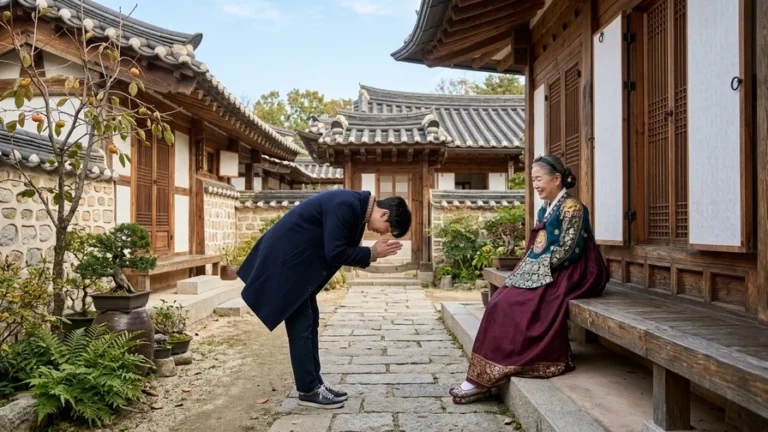
- A Formal Bow: Used with people you’re meeting for the first time, elders, or business partners. Bend the upper body roughly 15–30 degrees. You don’t need to memorize the angle as a traveler—just bow as much as the other person does.
- Handshake: Mostly used in business settings. It’s customary to respond when a senior person extends their hand first. Shaking with your right hand while lightly supporting your right elbow or wrist with your left hand shows even greater respect.
The Two-Hand Rule
This custom comes up about as often as greetings do. When handing over or receiving something—a card, cash, a gift, documents—use both hands, or offer it with your right hand while supporting your right arm with your left. That’s why you’ll see a convenience store clerk return your card with both hands. No one will get upset if a traveler uses one hand, but using two instantly marks you as “someone who knows the manners.”
Basic Korean Greetings
These are basic phrases you can use in any situation.
| Korean | Pronunciation | English | Context |
|---|---|---|---|
| 안녕하세요 | An-nyeong-ha-se-yo | Hello | The most universal greeting. Works any time of day. |
| 감사합니다 | Gam-sa-ham-ni-da | Thank you | A formal and polite expression of thanks. |
| 죄송합니다 | Joe-song-ham-ni-da | I’m sorry | Used when you’ve made a mistake or want to apologize. |
| 잘 먹겠습니다 | Jal meok-get-seum-ni-da | I will eat well | Said before a meal to the person who cooked or paid for it. |
| 잘 먹었습니다 | Jal meo-geot-seum-ni-da | I have eaten well | Said after finishing a meal as a way of giving thanks. |
2. Dining Etiquette
Korean food culture is community-centered. Since several people often share side dishes, dining etiquette matters.
Basic Rules at the Table
- Elders First: At a meal with elders present, wait until the eldest person picks up their spoon. This doesn’t apply when eating with friends or dining alone at a restaurant.
- Do Not Lift Your Bowl: Don’t pick up your rice or soup bowl to eat. Leave the bowl on the table and eat with your spoon and chopsticks. This is the biggest difference from Japanese and Chinese food culture, where lifting the bowl is normal.
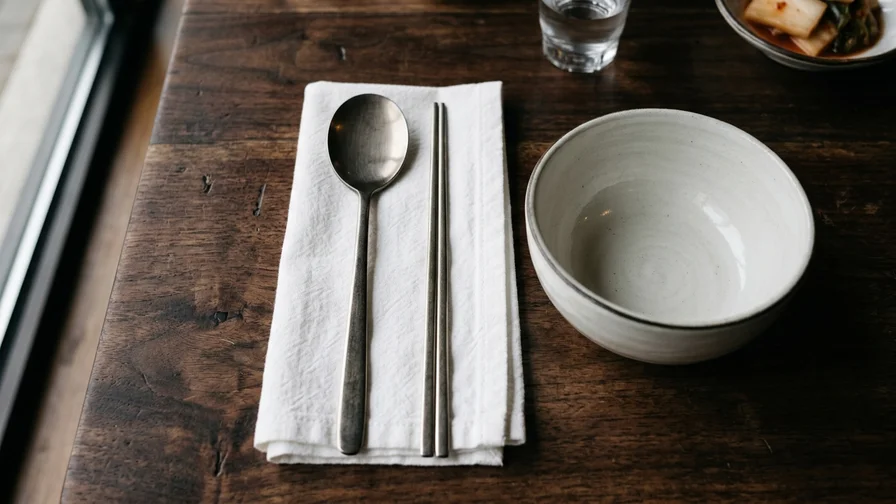
- Spoon and Chopsticks: Use the spoon for rice and soup, and chopsticks for side dishes. Don’t hold both in one hand at the same time. And never stick your chopsticks upright in your rice—it recalls ancestral memorial rites and is taboo.
- Eating Noises: Smacking or chewing loudly is considered impolite. That said, slurping noodle dishes like ramyeon or guksu is accepted as natural.
- No Nose-Blowing: Blowing your nose at the table is seen as very rude. If spicy food makes your nose run, it’s best to step into the restroom.
- Leaving Food: Leaving food itself is fine. Still, there’s a sentiment that finishing what’s been served shows respect to the cook, so it’s best not to leave rice in particular.
Practical Restaurant Tips—What Trips Up Foreigners Most
More mistakes come from differences in the system than from etiquette. Just knowing the points below will keep you from getting lost at a restaurant.
- Call staff with the buzzer: Many restaurant tables have a call buzzer attached. Instead of waiting to make eye contact with a server, just press the buzzer. Where there’s no buzzer, calling out “Jeo-gi-yo” (excuse us) is not rude.
- Water and side dishes are self-serve or free: Water is commonly self-serve from a dispenser near the entrance or along the wall. Side dish refills are mostly free, so asking for “more banchan, please” or using the self-serve corner is perfectly normal.
- Utensils are in the table drawer or holder: If you don’t see any utensils, check the drawer on the side of the table or the stainless steel holder on top. Napkins are often kept there too.
- Pay at the counter: Rather than handing your card to a server at the table, most restaurants expect you to go to the counter by the entrance and pay directly after your meal. Don’t sit and wait for the bill.
Banchan (Side Dishes) and Sharing Culture
Korean meals are characterized by a variety of side dishes placed in the center of the table and shared by everyone. Kimchi, namul (seasoned vegetables), jorim (braised dishes), and more come as standard.
- Helping yourself to banchan: At most restaurants, it’s normal to take from the shared side dishes with your own chopsticks. If hygiene concerns you, just ask for a small individual plate.
- Shared tongs or chopsticks: At more formal Hanjeongsik (a traditional Korean multi-course set meal) restaurants, separate communal tongs or chopsticks are provided for serving. In that case, you must use the shared utensils.
Drinking Etiquette
In Korea, drinking gatherings are an important part of socializing and business. There are a few rules.
- Receiving a Drink: When a senior or elder pours you a drink, receive the glass with both hands. Holding the glass with one hand while supporting it with the other carries the same meaning.
- Pouring a Drink: When a junior pours for a senior, hold the bottle with both hands.
- Turning Your Head: When drinking with a senior, it’s polite to turn your head slightly to the side as you drink. It’s a custom to avoid facing the senior directly while drinking.
- No Self-Pouring: Pouring into your own glass (jajak) is generally avoided. The norm is to fill others’ empty glasses and wait for someone to fill yours.
- Refusing a Drink: If you don’t want to drink, you can politely decline by saying “Gwaen-chan-seum-ni-da” (I’m fine). Lightly placing your hand over the glass is also a way to refuse. The culture of pressuring people to drink has faded a lot.
3. Public Space Etiquette
In big cities like Seoul, where many people share limited space, public-space etiquette is important.
Public Transportation
- Lining up: On subway platforms, line up on either side along the lines marked on the floor, and board only after everyone has gotten off. Lining up is the norm at bus stops too.
- Priority Seats: The sections at both ends of each subway car are priority seats for the elderly, people with disabilities, pregnant women, and those accompanying infants. Even on a crowded train, younger people generally avoid sitting there.
- Pink Seats: Separate from the priority seats, each car has two pink pregnancy seats, where the seat and even the floor are painted pink. They’re for pregnant women whose pregnancy isn’t visible yet, such as in early stages, so it’s become good manners to leave them empty even when no one is sitting there. This is the seat foreigners get called out for the most.
- Keep noise down: Avoid talking loudly or taking phone calls inside the car. Calls aren’t outright banned, but it’s normal to keep them short and quiet or to text instead. Always use earphones for videos or music.
- Escalators: Officially, standing in two lines and not walking is recommended, but in practice the custom of standing on the right and leaving the left open is strong. Standing on the left and blocking the way can earn you dirty looks.
Removing Shoes
In Korea, you’ll often take your shoes off when entering indoor spaces. It’s a custom rooted in the ondol floor-seating culture, where people sit and lie on the floor.
- Private homes: In every home, you take your shoes off at the entryway. No exceptions.
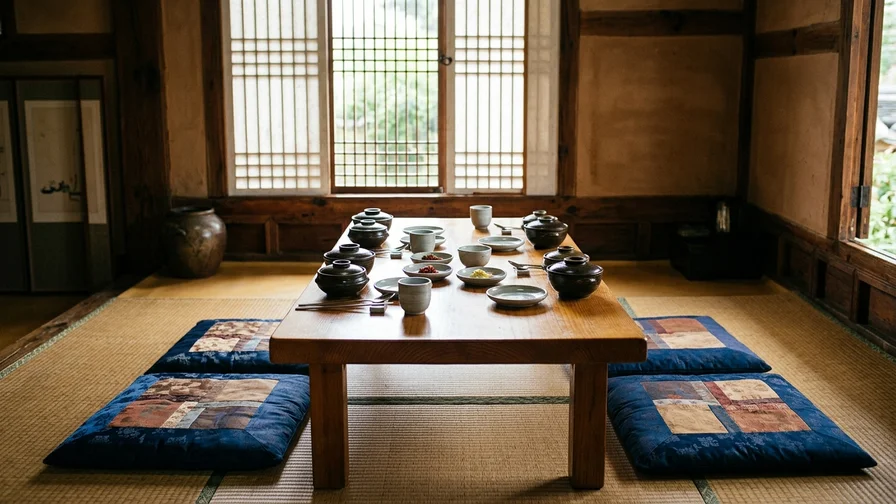
- Some restaurants: Korean restaurants with floor seating require you to remove your shoes before entering. There’s a shoe rack at the entrance.
- Temples and traditional houses: You also take your shoes off when entering a temple’s main hall or stepping up onto the wooden floor of a Hanok (a traditional Korean house). Inside the hall, remove your hat and check whether there are no-photography signs.
Editor’s Tip: If there’s any chance you’ll visit a place where shoes come off, wear easy slip-on shoes and make sure your socks don’t have holes.
Why You Can’t Find a Trash Can
This is the first practical problem foreigners run into on Korean streets. Since the volume-based waste fee system was introduced in 1995, public trash cans on the street have dwindled dramatically, making it hard to find a place to toss what’s in your hand.
- Where to find trash cans: Inside subway stations, in front of convenience stores (for customers who bought something there), in parks, and at some bus stops. Carrying a small bag and disposing of trash at your accommodation or a station is the practical approach.
- Recycling: If a bin is split into General and Recycling, put plastic cups, PET bottles, and cans on the recycling side. As a rule, empty out any leftover drink before tossing the cup.
- No littering: Throwing cigarette butts or trash on the street is subject to a fine. Enforcement isn’t constant, but there’s a reason the streets are clean.
Smoking Rules
Korea’s smoking regulations are tighter than you might expect. These rules are current as of June 2026.
- Fully smoke-free indoors: The interiors of businesses—restaurants, cafés, bars, internet cafés (PC bang), and more—are legally smoke-free across the board. Some buildings have separate smoking rooms.
- Street no-smoking zones: In Seoul, areas such as median-lane bus stops, within 10m of subway station entrances, plazas, and major parks are designated no-smoking zones. Fines for violations range from about 50,000 to 100,000 won depending on the district.
- Finding a smoking area: Don’t smoke on the street—look for a booth or designated spot marked “Smoking Area.” They’re often set up in busy alleys or behind buildings.
- E-cigarettes count too: E-cigarettes and vape devices fall under the same no-smoking zone rules as regular cigarettes.
Drinking in Public
Surprisingly, drinking in public is legal in Korea. Having a beer at a table in front of a convenience store, or enjoying chimaek (fried chicken and beer) at Hangang Park, is a classic part of Korean culture (as of June 2026). That said, some parks are designated alcohol-free zones, and if you drink and cause a disturbance—shouting, singing loudly—you may be fined. The key isn’t the “drinking” but “not being noisy.”
4. Other Useful Cultural Notes
Photography
Points to keep in mind when taking photos while traveling.
- Photos of people: If you want to photograph a specific person identifiably, always ask for their consent first. Korea has a strong awareness of portrait rights.
- No-photography areas: Many museums, art galleries, and parts of some temple interiors prohibit photography. Check for a camera with an X over it. Photography around military and security facilities is strictly forbidden.
Tipping Culture
Korea has no tipping culture. This one fact alone takes a lot of stress out of traveling.
- Restaurants and taxis: The price shown is all you pay. There’s no need to tip, and no one expects it. If anything, offering a tip often leaves the staff flustered and trying to give it back.
- Hotels: At a luxury hotel, handing about 5,000 won when a porter carries your luggage or you receive a special service is fine, but it’s not obligatory.
- Tour guides: If you were satisfied with a private tour, giving the guide or driver a tip at the end as a token of thanks is perfectly natural.
Korean Age
Since June 2023, Korea has unified its legal and social age calculation to the international standard “manse” (counted) age. That means the age on your passport matches your age in Korea. One exception: the purchasing age for alcohol and tobacco still uses a “year age” standard under the Youth Protection Act—”from January 1 of the year you turn 19.” It’s common for convenience stores and bars to ask younger-looking customers for ID, so just show your passport.
Essential Info for International Travelers
Editor’s Tip: Information that’s very handy to know when traveling in Korea (as of June 2026).
- Kakao T (taxi app): It’s the most-used taxi-hailing app in Korea and offers an English interface, but it has limits for foreign travelers. Foreign-issued credit cards can’t be registered for in-app auto-payment, and registering a card requires verification with a Korean mobile carrier number. The fix is simple—when you hail a ride, choose “pay the driver directly” as the payment method, and you can pay at drop-off with cash, a physical foreign-issued Visa/Mastercard, or a T-money card. Just note that hailing a ride can be tough during morning and evening rush hours.
- 1330 Korea Travel Helpline: A 24/7, year-round tourist information service run by the Korea Tourism Organization. Tourist information, interpretation support, and even filing tourist complaints can all be handled with a single phone call. For more details, see the official Government24 information page.
- Phone number: Within Korea, dial 1330 (no area code); from overseas, +82-2-1330
- Hours: 24 hours, year-round
- Languages supported: Korean, English, Japanese, Chinese, Russian, Vietnamese, Thai, and Malay-Indonesian (8 languages)
- Separate numbers for emergencies: 112 to report a crime, 119 for fire and ambulance (both can connect you to a foreign-language interpreter)
I hope this guide helps you understand Korean culture and enjoy a great trip. Rules like fines and regulations can change, so it’s a good idea to double-check with the official helpline (1330) before your visit.
Related Reads on This Topic
- First Time in Korea? Your Pre-Departure Checklist from Visa to SIM and Payments
- Essential Korea Travel Apps, Starting with Kakao and Naver
- South Korea Travel Insurance, What to Cover and What It Costs
- Feeling Sick in Korea? How to Find Pharmacies & Pack a Medical Kit
- Staying Connected in Korea With a SIM, eSIM or Pocket WiFi