Bangudae Petroglyphs (UNESCO 2025)
Contents
- The 2025 Inscription — Why a 7,000-Year-Old Set of Drawings Has Global Value
- What Was Carved — Whales, Hunting, and Harpoons
- Daegok-ri Bangudae vs. Cheonjeon-ri — The Difference Between the Two Sites
- Ulsan Petroglyph Museum — Films, Replicas, and Commentary (Free)
- Free Shuttle Bus (Running Since April 2026)
- Getting There — How to Reach Bangucheon from Seoul
- Sayeon Dam and Conservation — Why There’s a Submersion Problem
- Practical Tips for Foreign Travelers
- Frequently Asked Questions (FAQ)
On July 12, 2025, the 47th session of the World Heritage Committee, held in Paris, France, confirmed Korea’s 17th UNESCO World Heritage Site. The Bangudae Petroglyphs along the Bangucheon Stream in Ulsan are a record of images and inscriptions that people carved into the rock over roughly 6,000 years, beginning around 5000 BCE — making them Korea’s first prehistoric rock-art site to be inscribed on the World Heritage List. More than 900 figures, including whales, tigers, and deer (about 300 at Bangudae and more than 620 at Cheonjeon-ri), vividly document the daily life and hunting culture of the time. There’s one thing you should know before you go — you actually view the petroglyphs from an observation deck across the river, looking through a telescope from a distance, and they may be submerged and invisible depending on the water level of Sayeon Dam.
Key Information at a Glance
- What: Carvings of animals, hunting scenes, and inscriptions made from around 5000 BCE (Neolithic) through the Silla period (9th century). Korea’s 17th UNESCO World Heritage Site (inscribed July 12, 2025)
- Where: An area roughly 3 km long along the Bangucheon Stream in Ulju-gun, Ulsan. The core sites are the Bangudae Petroglyphs at Daegok-ri and the Cheonjeon-ri Inscriptions and Petroglyphs
- How: Start at the Ulsan Petroglyph Museum (free, closed Mondays) to see the full-size replicas first → take the free shuttle bus (running Wednesday–Sunday) to the two sites. You view the originals through telescopes from an observation deck
- When: Avoid Mondays, when both the museum and the shuttle bus are closed. Visiting Wednesday through Sunday, when the shuttle runs, is the way to go
- Information accuracy: The opening hours, fees, and shuttle bus details in this article are confirmed as of June 2026
The 2025 Inscription — Why a 7,000-Year-Old Set of Drawings Has Global Value
Fifteen years after being added to UNESCO’s Tentative List in 2010, the Bangudae Petroglyphs were finally inscribed as a World Heritage Site at the 47th session of the World Heritage Committee on July 12, 2025 (official UNESCO inscription page). The inscription was based on two criteria — (i) a masterpiece of human creative genius, and (iii) unique testimony to a vanished cultural tradition. Unlike most prehistoric sites, which survive in the form of tools or dwellings, the Bangudae Petroglyphs show us directly, in pictures, how people of the time thought and lived.
- A detailed depiction of a marine hunting culture that pursued both sea and land animals
- Observation skills sharp enough to tell whale species apart by their spout shapes and body proportions
- Records of complex activities — scenes of harpooning whales, moving by boat, and more. Rock art depicting the whaling process is rare even on a global scale (per UNESCO’s assessment)
- A carving tradition that continued in the same valley for roughly 6,000 years, from 5000 BCE to the 9th century CE
- Outstanding Universal Value (OUV) that shows the cultural evolution of a prehistoric coastal community in a single location
What Was Carved — Whales, Hunting, and Harpoons
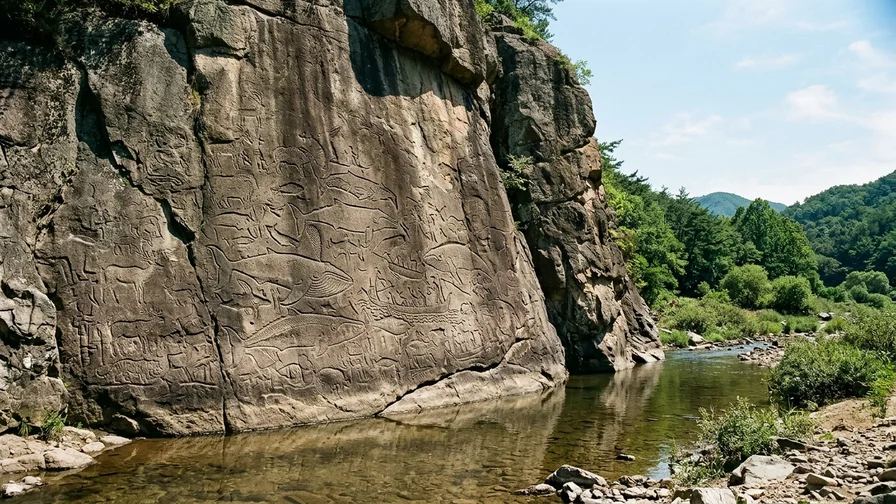
More than 300 figures are carved here. They fall broadly into animals, people, and tools. The most celebrated of all are the whale drawings.
- Whales: Around 60 figures are whales alone. Depending on the study, anywhere from 7 to 11 species have been identified, including the North Pacific Right Whale, Humpback Whale, Gray Whale, Sperm Whale, and Orca. Ecological details are rendered accurately — a mother whale carrying her calf, a whale spouting water, and more. It is regarded as one of the oldest records of whaling in the world
- Land animals: Many predators and grazing animals that once inhabited the Korean Peninsula, such as tigers, leopards, wild boars, and deer. Deer are shown moving in herds
- People and hunting gear: Dynamic depictions of people rowing boats, and hunters firing bows or throwing harpoons. These are records of purposeful, specific activities
When you look at the replicas in the museum, one figure you must seek out is the mother Gray Whale carrying her calf on her back. Read it together with the harpooned whale beside it and the drawing of a boat tethered by a line, and you’ll see that the entire process of prehistoric whaling — observation, hunting, distribution — is captured on a single rock face. It shows how prehistoric people interacted with nature to secure food and survive.
Daegok-ri Bangudae vs. Cheonjeon-ri — The Difference Between the Two Sites
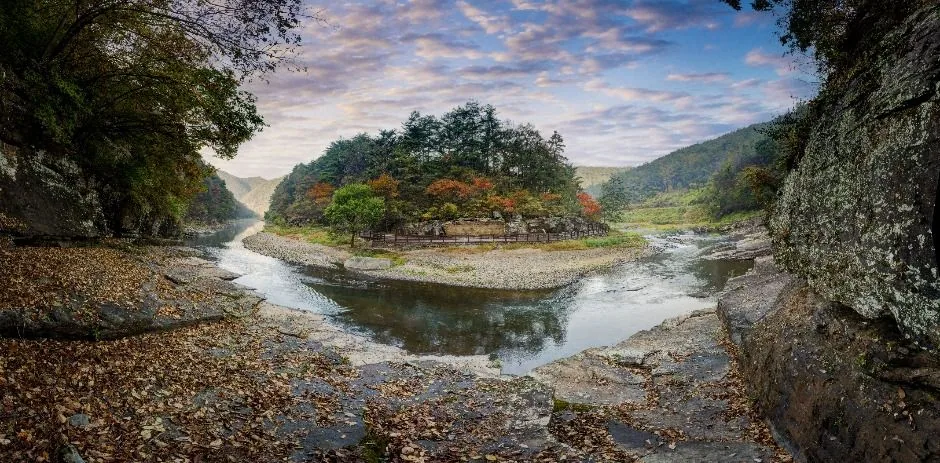
The Bangudae Petroglyphs are not a single location but a collective name for the sites distributed along roughly 3 km of the Bangucheon Stream valley. The two core spots are the Bangudae Petroglyphs at Daegok-ri and the Cheonjeon-ri Inscriptions and Petroglyphs.
Bangudae Petroglyphs at Daegok-ri (National Treasure)
- The drawings are concentrated on a cliff face about 8 m wide and 4.5 m high
- Discovered in 1971. Most of the whale and hunting scenes are located here
- Believed to date from the Neolithic to the Bronze Age. A concentration of hunting and fishing culture
- It repeatedly submerges and re-emerges depending on the water level of Sayeon Dam — the heart of the conservation problem (see the separate section below)
- Viewing is done with telescopes installed at an observation deck across the river — about 1.2 km (roughly 20 minutes) on foot from the museum along the Daegokcheon Stream trail
- Address: Around 285 Bangudae-angil, Eonyang-eup, Ulju-gun, Ulsan
- Google Maps: Bangudae Petroglyphs at Daegok-ri
Cheonjeon-ri Inscriptions and Petroglyphs (National Treasure)
- About 2 km upstream along the Daegokcheon Stream from the Bangudae Petroglyphs. Records from several different eras overlap on a single rock
- Upper section: prehistoric geometric patterns (concentric circles, lozenges) and animal drawings
- Lower section: inscriptions in Chinese characters and fine line drawings carved by people of the Silla Dynasty during the Three Kingdoms period using sharp metal tools — there are records left by 6th-century Silla royalty and the Hwarang (an elite corps of young men). This is evidence that the place was regarded as sacred for a long time, from prehistoric into historic times
- It was originally called the “Cheonjeon-ri Engraved Rock in Ulju,” but in February 2024 the official name was changed to the “Cheonjeon-ri Inscriptions and Petroglyphs in Ulju” — older maps and signs may still carry the old name
- Unlike Bangudae, you can walk right up to the rock here. Dinosaur footprint fossils also remain on the rock floor on the opposite side
- Address: Around San 210, Cheonjeon-ri, Dudong-myeon, Ulju-gun, Ulsan
- Google Maps: Cheonjeon-ri Inscriptions and Petroglyphs
Ulsan Petroglyph Museum — Films, Replicas, and Commentary (Free)
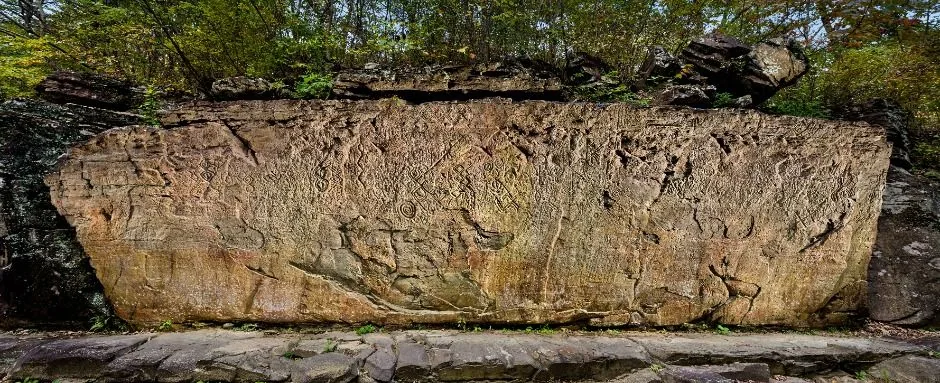
The actual petroglyphs are far away and may be invisible depending on the water level, so they’re hard to make out with the naked eye. That’s why every visit should begin at the Ulsan Petroglyph Museum. Full-scale replicas and high-definition films explain the carvings in detail, and only after familiarizing your eyes with the figures here will you understand what you’re looking at from the on-site observation deck.
- Main exhibits: full-scale replica of the Bangudae Petroglyphs, replica of the Cheonjeon-ri Petroglyphs, reconstructions of prehistoric daily life, a rubbing experience, and a screening room
- Admission: Free
- Opening hours: 09:00–18:00 (last entry 17:30) — as of June 2026
- Closed: Every Monday (if Monday is a public holiday, it closes the following day), and January 1
- Address: 254 Bangudae-angil, Dudong-myeon, Ulju-gun, Ulsan
- Phone: 052-229-4797
- Official website: Ulsan Petroglyph Museum official page
- Google Maps: Ulsan Petroglyph Museum
Free Shuttle Bus (Running Since April 2026)
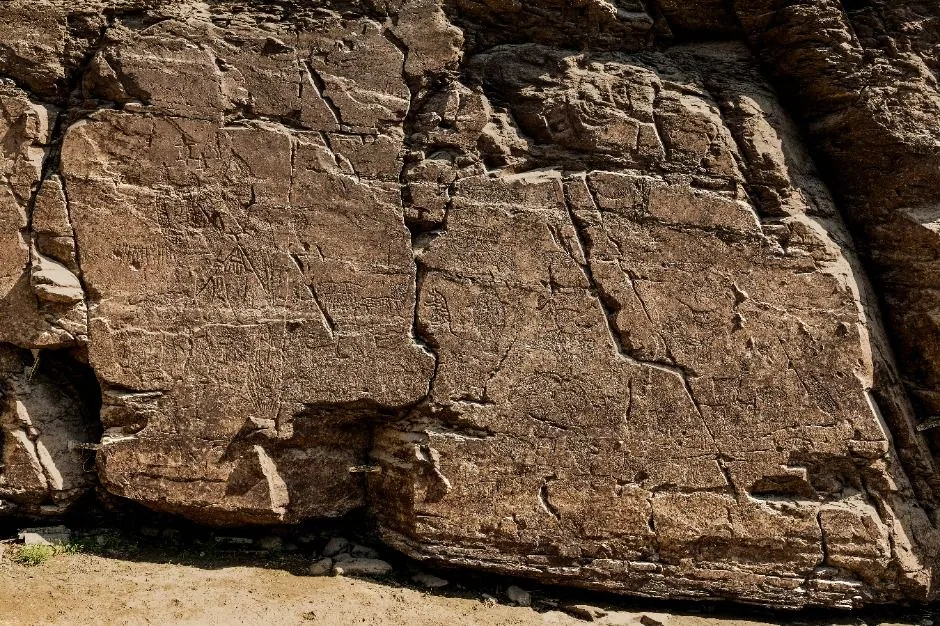
The Bangucheon area has poor public-transit access, which made independent visits difficult. After visitor numbers surged following the World Heritage inscription, the city of Ulsan has been running a free shuttle bus since April 24, 2026. It connects the museum, the Bangudae Petroglyphs, and the Cheonjeon-ri Inscriptions and Petroglyphs, making it effectively the only way to get around on-site for travelers without a car.
- Operating days: Wednesday–Sunday (5 days a week; not running Mondays or Tuesdays) — as of June 2026
- Fare: Free
- Frequency: 8 runs a day, first departure at 09:50 (departing from the Bangudae Petroglyphs parking lot)
- Stops: Bangudae Petroglyphs parking lot → Petroglyph Museum → Bangudae Entrance bus stop → Guryangcheonjeon bus stop → Ulsan Daegok Museum → Cheonjeon-ri Inscriptions and Petroglyphs entrance (loop)
- Checking the timetable for each run: It’s posted on signs at major stops such as the Petroglyph Museum and on Ulsan’s official social media. The surest approach is to call the Ulsan Petroglyph Museum (052-229-4797) before you set out
Build your itinerary around Wednesday through Sunday: Monday isn’t worth a visit since the museum is closed and the shuttle doesn’t run, and Tuesday has no shuttle either, so you’d be stuck moving only on foot and by taxi. Building your itinerary around Wednesday through Sunday is rule number one for this trip.
Getting There — How to Reach Bangucheon from Seoul
Coming from Seoul, the usual route is to take the KTX high-speed train to Ulsan and then use local transport.
Step 1: Seoul → Ulsan (KTX)
- Departure station: Seoul Station
- Arrival station: Ulsan Station (Tongdosa) — this is a KTX-only station located to the west toward Eonyang rather than in downtown Ulsan, which actually works in your favor since it’s in the same area as the Bangucheon sites
- Travel time: about 2 hours 10 minutes to 2 hours 20 minutes on the faster trains, and around 3 hours on trains with more stops (verified October 2026)
- Fare (standard seat): about 43,000 to 48,000 won (about $31 to $35) after the September 2026 KTX fare cut, varies by train (verified October 2026)
- Booking: The official Korail website (www.korail.com) or the KorailTalk app
Step 2: Ulsan Station → Petroglyph Museum
About a 30-minute drive from Ulsan Station. Public transit is very sparse, so we recommend the following options in order.
- Taxi (most realistic): Board at the Ulsan Station taxi stand and give your destination as the “Ulsan Petroglyph Museum.” Expect roughly 25,000–30,000 won (about $19–$23) on the meter, though it varies with traffic. Kakao T supports registering foreign-issued cards, and Uber works in Ulsan too. The real variable isn’t the app but the cars — in outlying areas like Dudong-myeon, you’ll struggle to hail a taxi for the return even if you request one, so it’s safest to arrange the return trip (and whether to charter the cab round-trip) with the driver on the way in
- City bus + shuttle bus combination: Ulsan’s city bus network was completely renumbered in December 2024 — the bus numbers in older blog posts no longer apply. Currently, the city bus that runs via Ulsan Station toward the Petroglyph Museum (the supplementary route No. 383) operates only about 3 times a day, very sparsely. Otherwise, you can take bus No. 313 (18 trips a day, every 40–70 min) or No. 333 (6 trips a day) from Ulsan Station to the Bangudae Entrance stop and transfer to the free shuttle bus there (verified October 2026). Before setting out, be sure to check the day’s timetable at the Ulsan Transportation Management Center (its.ulsan.kr) or via the route search on KakaoMap/Naver Map
- Rental car: Available if you hold an International Driving Permit (IDP). There are plenty of rental car agencies near Ulsan Station. Search “Ulsan Petroglyph Museum” in the navigation. Parking in the area is free
Sayeon Dam and Conservation — Why There’s a Submersion Problem
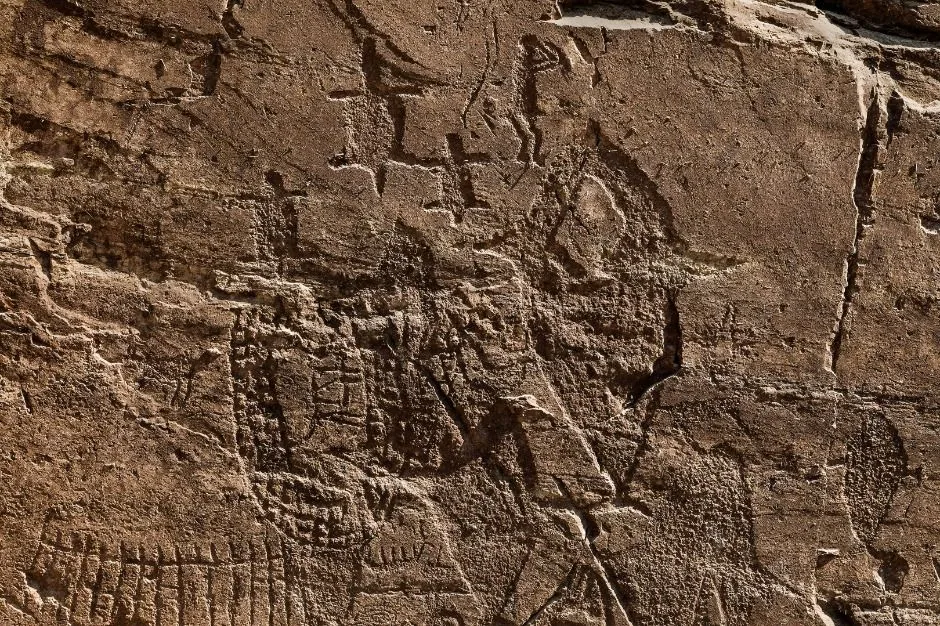
The Bangudae Petroglyphs at Daegok-ri become submerged when the water level rises because of Sayeon Dam, completed in 1965. That’s because the petroglyphs’ existence was unknown when the dam was built (they weren’t discovered until 1971).
- In the past they were sometimes submerged for more than half the year, but after the Daegok Dam was built upstream in 2005 and water-level management was reinforced, the submersion period shrank dramatically (recent figures cited average around just over a month a year)
- Even so, the repeated cycle of submersion and exposure itself weakens the rock surface, and the drawings are fading
- The UNESCO inscription is an important catalyst for solving the problem — the central government and the city of Ulsan are pursuing permanent measures to lower the water level, such as installing floodgates on Sayeon Dam
- Whether the petroglyphs will be exposed above the water on the day of your visit depends on rainfall and is hard to predict. If exposure matters to you, you can call the museum (052-229-4797) before visiting to check
Practical Tips for Foreign Travelers
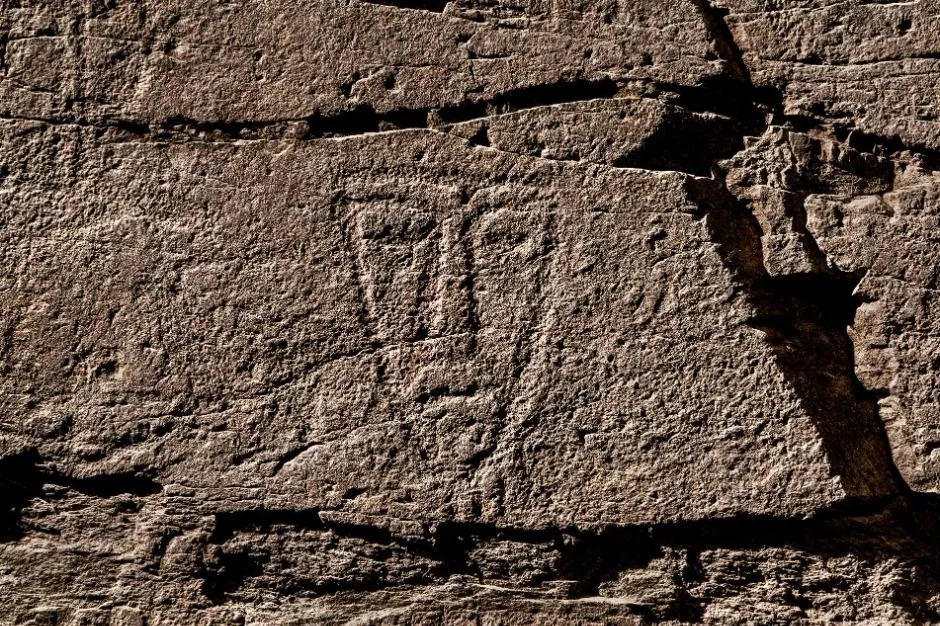
- Viewing order: (1) Build your background knowledge with the replicas and films at the Ulsan Petroglyph Museum → (2) reach the Bangudae Petroglyphs observation deck, either on foot along the Daegokcheon Stream trail (about 20 minutes) or by shuttle bus → (3) take the shuttle to the Cheonjeon-ri Inscriptions and Petroglyphs → (4) return to the parking lot by shuttle
- Viewing the actual petroglyphs: The Bangudae Petroglyphs are viewed with telescopes installed at the observation deck across the river. Even when the water level is low and they’re exposed, the distance makes fine details hard to discern — so you’ll want to have seen the drawings at the museum first to recognize “ah, that’s the rock face.” The value lies in the experience of standing before the actual rock. Many reviews say Cheonjeon-ri is more satisfying since you can see it right up close
- Tourist information hotline 1330: A 24-hour foreign-language service in English, Japanese, Chinese, and more. Dial 1330 directly within Korea (or +82-2-1330 when roaming from abroad)
Restaurants Nearby — Around the Sites and Eonyang Bulgogi
There are very few restaurants right around the petroglyph sites — the two below are about all there is, so be sure to check the hours. For a proper meal, the answer is the town of Eonyang, a 15–20 minute drive away. Eonyang is the home of Eonyang Bulgogi (thinly minced and seasoned Korean beef grilled over charcoal on a wire mesh), a town that Koreans will travel to just for this one dish. Operating information is as of June 2026.
| Name | Recommended dish | Address |
|---|---|---|
| Bangudae Gukbap 📍 | Dwaeji-gukbap (pork-and-rice soup, 9,000 won) — a clear pork broth with rice mixed in, a signature working-class dish of the Busan–Ulsan region. Open weekdays 11:00–15:00 only, closed on weekends, so weekend visitors can’t use it | 1459 Bangudae-ro, Dudong-myeon, Ulju-gun, Ulsan |
| Amgakhwa Sajin Sogeuro 📍 | Dotori-muk — a slightly bitter jelly dish made by setting acorn starch and tossing it in seasoning sauce. A rustic eatery on the road into the site that mainly serves freshwater fish dishes | 306-15 Bangudae-angil, Eonyang-eup, Ulju-gun, Ulsan |
| Eonyang Giwajip Bulgogi 📍 | Eonyang Bulgogi — converted from an old tiled-roof house and regarded as the oldest Eonyang Bulgogi restaurant. Uses only female Korean cattle and has appeared on numerous TV food shows. Open 11:00–21:00 | 86 Heonyang-gil, Eonyang-eup, Ulju-gun, Ulsan |
| Gongwon Bulgogi 📍 | Wire-mesh seasoned bulgogi, yukhoe (beef tartare) — a long-established shop in the bulgogi alley across from the Eonyang terminal. Known for selecting its cattle directly at the cattle market | 32 Heonyang-gil, Eonyang-eup, Ulju-gun, Ulsan |
| Eonyang Jinmi Bulgogi 📍 | Eonyang Bulgogi, yukhoe — part of the original lineage that began at an Eonyang butcher shop in the 1960s. There are many shops with similar names, so check that you’re at the main branch at 33 Jungpyeong-ro, Samnam-eup. Open 11:00–21:00 | 33 Jungpyeong-ro, Samnam-eup, Ulju-gun, Ulsan |
What to Bring
- There’s a valley trail (about 1.2 km) from the museum to the petroglyph observation deck, so comfortable shoes are a must
- Depending on the weather, a hat, sunglasses, and drinking water are recommended — there are almost no shops around the site
Frequently Asked Questions (FAQ)
- Q1: Can I see the actual petroglyphs with my own eyes?
- A: Yes, you can see them. However, the Bangudae Petroglyphs at Daegok-ri are far away across the river, so you make out the shapes through telescopes installed at the observation deck. If the water level of Sayeon Dam is high, they may be submerged and invisible. The Cheonjeon-ri Inscriptions and Petroglyphs can be viewed right up close. For the fine details of the drawings, the full-scale replicas and films at the Ulsan Petroglyph Museum are the most accurate way to see them.
- Q2: How long does it take to see everything?
- A: Including the museum visit (1 hour), the round trip to the Bangudae Petroglyphs (1 hour), the round trip to the Cheonjeon-ri Inscriptions and Petroglyphs (1 hour), plus shuttle travel and waiting time, we recommend planning for at least 3–4 hours.
- Q3: Is there an admission fee?
- A: No. The Ulsan Petroglyph Museum, the Bangudae Petroglyphs, and the Cheonjeon-ri Inscriptions and Petroglyphs are all free, and the shuttle bus is also running free of charge (as of June 2026).
- Q4: When is the best time to visit?
- A: The day of the week matters more than the season. You should go Wednesday through Sunday, when both the museum and the shuttle bus operate. As for the season, we recommend spring (April–May) and autumn (September–October), which are great for walking the trail. Whether the petroglyphs will be exposed above the water depends on rainfall and is hard to predict, so if you’re curious about exposure, calling the museum (052-229-4797) before your visit is the sure way to find out.
- Q5: Are there restrooms or amenities at the site?
- A: There are restrooms at the Ulsan Petroglyph Museum and the parking lot. The restroom near the Bangudae observation deck was removed in May 2026, and the nearest public restroom is about 700 m (roughly a 15-minute walk) from the deck, so use the museum restroom before heading there. There are almost no shops or cafés and no vending machines around the petroglyph site, so it’s best to bring drinks and snacks in advance (verified October 2026).
- Q6: Is it okay to go with children?
- A: Yes, it’s great. The Ulsan Petroglyph Museum has a children’s exhibition hall, a rubbing experience, and other audiovisual materials and hands-on facilities to help children easily understand prehistoric history and nature.
- Q7: Is photography allowed?
- A: Yes, photography for personal use is allowed both indoors at the museum and outdoors at the sites. However, flash photography is prohibited inside the museum.
The Bangudae Petroglyphs are not merely old drawings but a great record of communication left by humanity 7,000 years ago. As the most recently inscribed World Heritage Site, the shuttle bus and on-site facilities are still changing — we recommend reconfirming any potentially changeable information on the Ulsan Petroglyph Museum official page before you visit.
Some photos © Korea Tourism Organization (KOGL Type 1)
Related reads in this series
- 17 UNESCO World Heritage Sites in Korea
- Haeinsa Janggyeong Panjeon & Tripitaka Koreana (UNESCO 1995)
- Gyeongju UNESCO World Heritage (1995, 2000)
- Jongmyo Shrine (UNESCO 1995)
- Changdeokgung Palace & Secret Garden (UNESCO 1997)
- Andong Hahoe & Gyeongju Yangdong Villages (UNESCO 2010)
- Namhansanseong Fortress (UNESCO 2014)
- Baekje Historic Areas (UNESCO 2015)
- Sansa, 7 Buddhist Mountain Temples in Korea (UNESCO 2018)