
How Korean Crime Dramas Mirrored Their Times — A Genre’s Journey
목차
- The Birth (1970s–80s): The Era of “Investigation Headquarters” and Poetic Justice
- The 1990s to Post-IMF: Beginning to Doubt the Justice System
- The 2010s: A Golden Age of Specialization and Diversification
- The OTT Era (2019–): The Genre Steps Beyond Censorship
- Conclusion: A Mirror of Its Times, Forever Evolving
Key Takeaways
This is a chronological look at how Korean legal and crime dramas have evolved alongside the times, tracing the full evolution of Korean legal and crime dramas. It starts with the good-versus-evil detective stories of “Investigation Headquarters” (Susa Banjang), which premiered in 1971, then shifts toward narratives that question the justice system itself — shaped by the phrase “the rich go free, the poor go to jail,” born from the 1988 Ji Kang-heon hostage crisis, and by the 1997 IMF financial crisis. In the 2010s, the genre specialized and diversified into forensic science, cyber investigation, and gender issues. After 2019, OTT platforms like Netflix moved to the center of production, expanding the genre’s reach to subjects that broadcast TV had struggled to tackle — as seen in “D.P.” and “Juvenile Justice.”
This article focuses on that era-by-era evolution. If you’d first like the big picture of the genre — its appeal, its social messages, and recommended entry points — we suggest starting with K-Legal/Crime Drama.
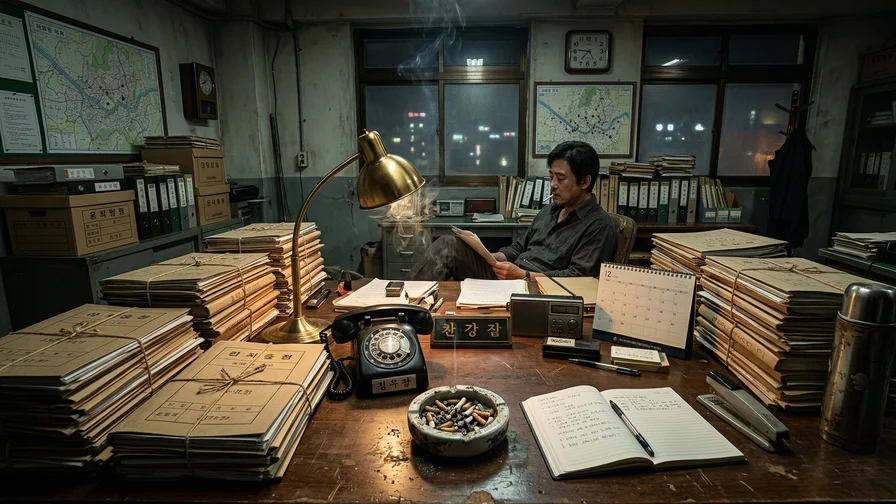
The Birth (1970s–80s): The Era of “Investigation Headquarters” and Poetic Justice
When people point to the starting line of the K-legal/crime dramas that now captivate viewers worldwide, the most frequently cited title is, without a doubt, “Investigation Headquarters” (Susa Banjang). Far from polished, it nonetheless laid the foundation for the entire genre.
“Investigation Headquarters” — The Original Detective Show That Ran for 18 Years
- Broadcast info: MBC, first aired March 6, 1971, and ended October 12, 1989. A total of 880 episodes. Its popularity was so overwhelming that after it wrapped at episode 681 in 1984, viewer demand brought it back in 1985.
- Premise: Detective Park (played by Choi Bul-am) and his fellow officers solve crimes based on real cases. What lingers in memory is less the thrill of catching the culprit and more the show’s humane gaze toward people driven to crime by poverty and hardship.
- Limitations: Due to censorship under the military government of the time, the show had no choice but to focus on individual wrongdoing rather than critique social structures.
- Program details and episode information are available on the official MBC Investigation Headquarters page.
The Era of Simple Good-Versus-Evil Storytelling
- The formula of early crime dramas: a virtuous hero overcomes adversity to punish the villain, and justice always prevails.
- In a turbulent era, these shows gave viewers psychological reassurance and a sense of vicarious satisfaction.
- The storytelling was one-dimensional, but the thrill of watching a capable, righteous investigator at work became the gateway that drew the public into the genre.
The 1990s to Post-IMF: Beginning to Doubt the Justice System
The genre’s first major turning point came in the late 1980s and 1990s. One real-life incident and one drama proved to be the watershed.
“The Rich Go Free, the Poor Go to Jail” — The 1988 Ji Kang-heon Hostage Crisis
- In October 1988, Ji Kang-heon and his accomplices escaped during a prison transfer and took a Seoul family hostage in their home — a scene broadcast live on television.
- What Ji Kang-heon cried out at that moment was “the rich go free, the poor go to jail” (yujeon mujoe, mujeon yujoe — if you have money you’re innocent, if you don’t you’re guilty). It went on to become a stock phrase symbolizing distrust of the justice system in Korean society, and countless legal and crime dramas have been built on this sentiment ever since.
“Sandglass” (1995) — The Moment a Prosecutor Became the Hero
- Broadcast info: SBS, January 9 to February 16, 1995, 24 episodes. Peak rating of 64.5%.
- It was such a phenomenon that streets emptied when it aired, earning it the nickname “the come-home-on-time clock.”
- The story follows a man who becomes a gangster (Choi Min-soo) and the prosecutor who must put him on trial (Park Sang-won), confronting the dark corners of modern Korean history and the collusion between power and the justice system. It’s regarded as the turning point that elevated the prosecutor into a central character type in Korean drama.
Post-IMF: The Individual Hero Versus the Corrupt System
- When the 1997 IMF financial crisis shook the public’s faith in national institutions, the courtrooms in dramas began to be portrayed not as spaces of absolute good but as battlegrounds for power struggles.
- Stories of the wealthy and powerful slipping through the net of the law while powerless ordinary people were sacrificed drew both public outrage and empathy.
- The narrative formula that crystallized in this period was “the individual hero who stands against a vast, corrupt system.” The incorruptible prosecutor and the lawyer who chases truth over money won public support and became the genre’s default template.
The 2010s: A Golden Age of Specialization and Diversification
As Korean society grew more pluralistic in the 2010s, the genre expanded explosively. Moving beyond simple social critique, it began to shine a professional, in-depth light on a wide range of issues — making this its most dynamic period.
The Rise of Professional Dramas
- “Sign” (SBS, 2011): Effectively the first drama to put a forensic pathologist from the National Forensic Service front and center. It was writer Kim Eun-hee’s breakout work and opened the door to the Korean-style forensic crime drama, in which cases are cracked through scientific evidence.
- “Ghost” (SBS, 2012): Foregrounding the cyber investigation unit, it tackled hacking and digital crime. Also a Kim Eun-hee work.
- “Stranger” (tvN, 2017): Dissects corruption within the prosecution from the perspective of a prosecutor himself. With no exaggerated heroics, it won on the strength of its meticulous plotting alone — widely cited as a landmark showing the genre’s maturity in the 2010s.
- The intellectual pleasure of glimpsing specialized fields like forensic medicine and digital forensics became a new driving force for the genre.
Reflecting Gender Issues and Human Rights
- “Witch’s Court” (KBS2, 2017): Centers on prosecutors in a unit dedicated to crimes against women and children. It directly confronts the investigation of sex crimes and gender discrimination within the legal profession.
- A string of works that listened to the voices of society’s vulnerable — addressing child abuse, domestic violence, and more — expanded the genre’s role beyond solving crimes to raising questions for society to grapple with together.
Editor’s Tip
If you want to enjoy K-legal/crime dramas on a deeper level, we recommend looking into the real social context behind the cases they depict. Many works draw their motifs from actual events, so reading the related news alongside the show makes the social critique come through far more clearly. For instance, after watching “Juvenile Justice,” you might look up Korea’s “criminally exempt minor” system (the age threshold below which a person isn’t subject to criminal punishment). It turns simple viewing into a window for understanding Korean society.
Breaking Down the Boundaries Between Genres
- “I Hear Your Voice” (SBS, 2013): A public defender and a boy who can read others’ minds — fantasy and romance woven into a legal drama.
- “Signal” (tvN, 2016): A setup involving a walkie-talkie that communicates with the past to pursue long-cold cases. Blending time-slip with crime drama, it became a textbook example of genre fusion (written by Kim Eun-hee).
- “The Fiery Priest” (SBS, 2019): Layering comedy over a crime investigation, it recorded a peak rating of 26.73% (Nielsen Korea) and topped the mini-series rankings for that year.
- Bold blends like these have become the engine that broadens the genre’s scope and draws in wider audiences. If you’re curious about the character types that drive the genre, we also recommend reading The Stories of Those Who Deliver Justice in K-Legal/Crime Dramas.

The OTT Era (2019–): The Genre Steps Beyond Censorship
The most recent turning point was a change in the platform itself. When “Kingdom,” released in January 2019, succeeded as Netflix’s first Korean original series, a path opened for Korean dramas to be made outside the constraints of broadcast scheduling and review boards.
- “D.P.” (Netflix, 2021): The story of a Deserter Pursuit (D.P.) team chasing army deserters. It used the grammar of the crime drama to unpack violence and abuse within the military — a subject broadcast TV had found hard to address head-on.
- “Juvenile Justice” (Netflix, 2022): A legal drama on juvenile crime and the Juvenile Act, told from the perspective of a juvenile court judge. In the second week of March 2022, it became Netflix’s number one non-English title worldwide — a first for a Korean legal drama. For official details, see the Netflix Juvenile Justice page.
- What OTT meant: seasonal production, freedom in episode runtime, and broader latitude in depiction — structurally widening the range of subjects the genre could tackle.
Looking ahead, new subjects such as cybercrime, the legal accountability of AI decisions, and cross-border crime networks are expected to fuel the genre’s next evolution. That said, this is only a forecast. One thing is certain: this genre has always been the quickest to absorb the anxieties of Korean society in any given era.

Conclusion: A Mirror of Its Times, Forever Evolving
From the poetic justice of “Investigation Headquarters” in 1971, to the distrust of the justice system in “Sandglass” in 1995, through the specialization and genre-blending of the 2010s, all the way to “Juvenile Justice” in the OTT era — the history of how Korean legal and crime dramas evolved is, in effect, the history of the questions Korean society has asked about justice. The reason this genre has been loved for so long is that, beyond the intrigue of solving cases, it has captured the pain of its times and the longing for justice more fiercely than anyone.
Now that you’ve followed the era-by-era flow, we encourage you to head to K-Legal/Crime Drama, which surveys the genre as a whole, to find recommended entry points and viewing notes.