The Shared Table — Korean Jeong and Community Seen Through K-Dramas
목차
Key Takeaways
- The table is much more than a place to eat: In Korean culture, the bapsang (the meal table) is a space that symbolizes family harmony, emotional bonds, and respect for guests.
- An expression of community spirit: The custom of sharing banchan (side dishes) and showing respect to elders reflects a community-minded spirit that values “us” over the individual.
- A medium for connection and reconciliation: The table serves as a space for starting awkward conversations, mending conflicts, and confirming each other’s feelings.
- Every drama cited here is a real production: Reply 1988 (tvN, 2015–2016), Crash Landing on You (tvN, 2019–2020), When the Camellia Blooms (KBS2, 2019), My Mister (tvN, 2018), and Let’s Eat (tvN, 2013–2014). Broadcast details are noted in the text.
When you watch K-dramas, certain scenes have a way of capturing your heart. They aren’t flashy action sequences or tender romances, yet they somehow warm you up and make your eyes sting: these are the “bapsang” scenes, where family, friends, or lovers gather together to share a meal. If you’ve ever wondered, “Why do Koreans love gathering to eat together so much?”, this article offers an answer. Through Korean dining culture in K-dramas, which carries a meaning far beyond a simple meal, we explore Koreans’ sense of community, their thoughtfulness, and the warm bond known as “jeong (情).” If you’d like to understand K-dramas from a broader perspective, it’s worth starting with the comprehensive Korean culture seen through K-dramas.
The Symbolic Meaning of the Table in K-Dramas: Bonds Beyond a Simple Meal
In K-dramas, the table is not merely a space for eating but a central stage where characters’ relationships and emotions intersect. This is evident even in everyday language:
- “Have you eaten?” / “Have you had your meal?” In Korea, these are used as greetings. They aren’t really asking whether you’ve eaten; they function much like “How are you?” in English, with the word “rice/meal” carrying the sense of caring for someone.
- “Let’s grab a meal sometime” is more than a simple plan; it’s an idiom that signals a desire to maintain the relationship and share one’s feelings.
- “Sikgu (食口)”, the word for “family,” literally means “people who eat from the same pot” in its Chinese characters. Eating together is, in effect, the very definition of family.
A Space for Family Harmony and Sharing Jeong
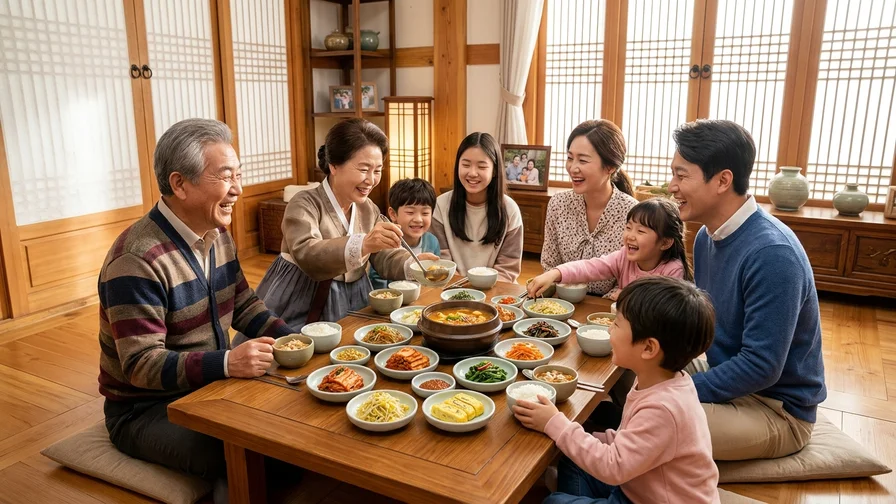
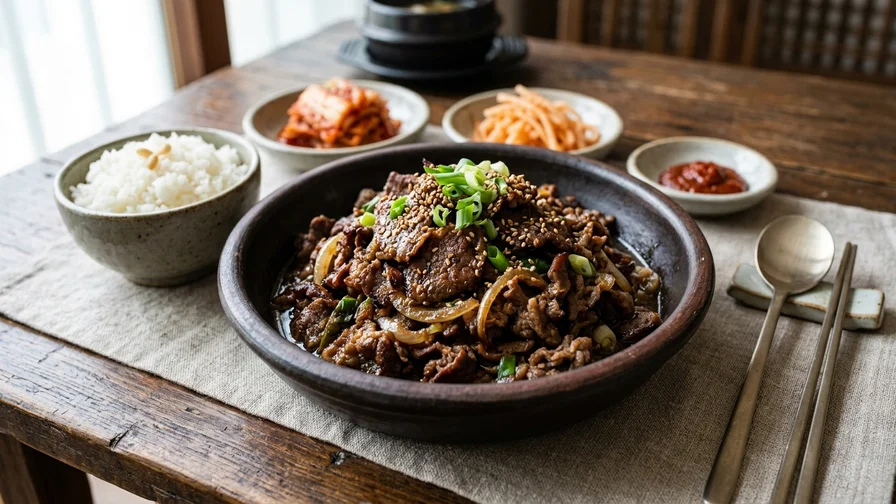
The first episode of Reply 1988 (tvN, 2015–2016) opens with neighbors in Ssangmun-dong, Seoul, carrying their evening side dishes to one another’s homes. One household’s bulgogi goes next door, the neighbor’s curry passes to another house, and around it all goes, until the modest table of a home without a mother becomes abundant with dishes from the entire alley. It’s a memorable scene that depicts another kind of family community, one that transcends blood ties. In this way, the table gathers scattered family members and neighbors into one place, helping them connect and strengthening their bonds. The sight of elders being honored at the center of the table and everyone dining together is a symbol of intergenerational connection and harmony, and it ties deeply into one of Korean society’s important values, explored in filial piety and family bonds in K-dramas.
The Korean Heart in Welcoming Guests
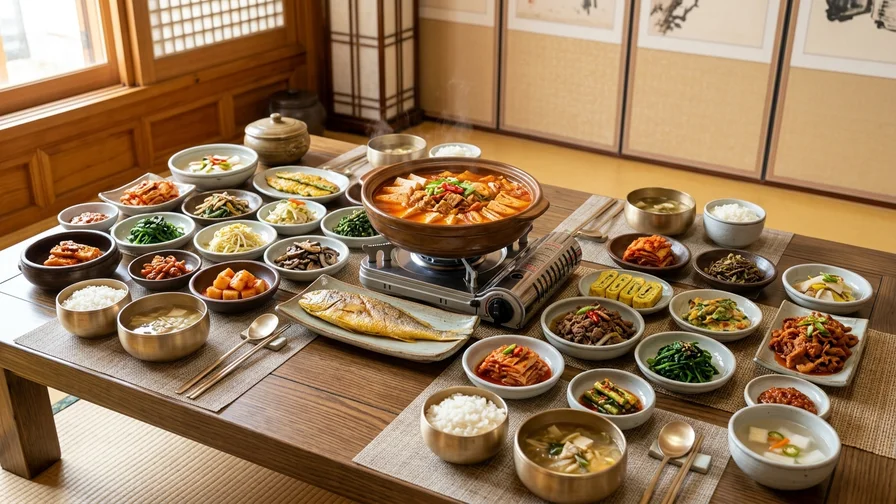
A good example comes from Crash Landing on You (tvN, 2019–2020), where the women of a North Korean village set out a full table of side dishes, each home contributing its own, for Yoon Se-ri, an unfamiliar guest from the South. It clearly reveals a culture of hospitality that offers the very best even to a first-time stranger. The tradition of laying out a “hanjeongsik” spread so generous the table legs nearly bend is likewise a way of expressing the utmost respect and care for a visitor through food. Korean dining culture in K-dramas carries this kind of welcome and gratitude that words alone cannot fully convey.
The Act of Eating Together: An Expression of Community and Consideration
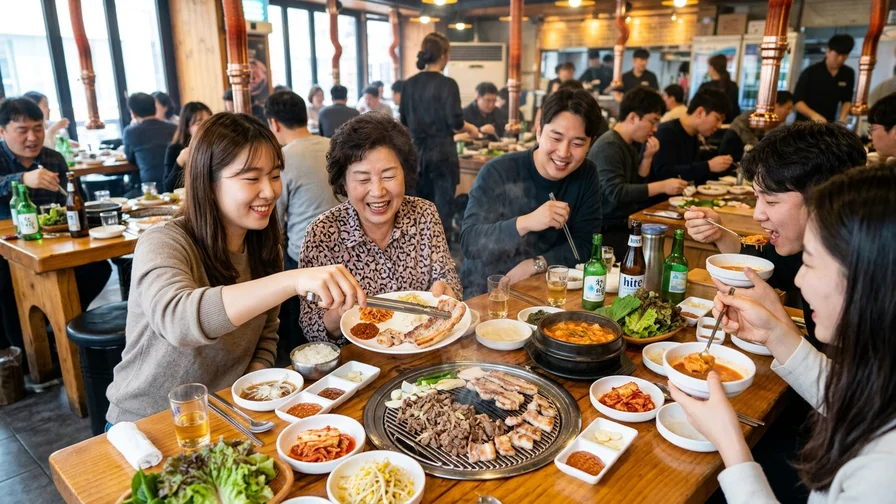
Korean food culture is built upon the value of “togetherness.” Unlike the Western style, where each person serves themselves on an individual plate, the defining feature of the Korean table is placing stews and side dishes in the center to share. This way of eating naturally nurtures a sense of community and teaches consideration for others.
Elders First, and the Custom of Sharing
If you watch family dining scenes in K-dramas closely, the following etiquette appears again and again. These are also practical points worth knowing if you happen to dine with elders during a visit to Korea:
- The meal begins after the elders pick up their utensils. The most senior member of the household must lift their spoon first before others follow and start eating. This expresses respect for elders, rooted in Confucian tradition.
- Rice and soup bowls stay on the table. Unlike in Japan or China, in Korea you don’t lift the bowl in your hand to eat. Rice and soup are traditionally eaten with a spoon.
- Use the spoon and chopsticks one at a time. In formal settings, the basic rule is not to hold both in one hand and use them simultaneously.
Several people scooping from the same stew or picking at shared side dishes may seem unhygienic, but it has long been a cultural device for strengthening the communal bond of “we are one.” Of course, in modern times the practice of serving portions onto individual plates for personal hygiene has spread, but the essence of sharing remains unchanged. You can learn more about Korean cuisine in general at the Hansik Portal run by the Korean Food Promotion Institute.
Conveying Feelings Through Food: The Heart of Korean Dining Culture in K-Dramas
For Koreans, food is a powerful language for expressing love, worry, and gratitude. In When the Camellia Blooms (KBS2, 2019), the market women of Ongsan initially give Dongbaek the cold shoulder, but eventually bring food and rice cakes to her shop, even using recycling as an excuse, conveying comfort and encouragement deeper than any words. Scenes of giving children yeot (taffy) to wish them success before exams, or cooking porridge by hand for an ailing friend, also show that Korean dining culture in K-dramas is a medium for conveying emotion. Understanding the care put into each dish makes the characters’ relationships read with far greater depth.
Editor’s Tip: Experiencing the Drama’s Table in Real Life (as of June 2026)
If you want to experience Korean dining culture firsthand, a hanjeongsik restaurant where a variety of side dishes and dishes are served as a course is the surest way. Three trusted spots in Seoul:
- Korea House 📍 — In a traditional hanok near Chungmuro Station, you can enjoy court-cuisine-based hanjeongsik alongside traditional performances. It’s the most refined introductory course for international visitors. Closed Sundays and Mondays, so reservations are essential before visiting.
- Yongsusan Biwon Branch 📍 — Near Anguk Station and Changdeokgung Palace, this is a long-standing establishment renowned for Kaesong-style hanjeongsik. With its tidy course menus, it’s a go-to spot for formal family introduction meals. Closed Mondays.
- Pilgyeongjae 📍 — Hanjeongsik served in a 500-year-old traditional hanok in Suseo-dong, Gangnam (the head house of the descendants of Prince Gwangpyeong, a son of King Sejong). There’s a break time (15:00–17:30), and reservations are recommended.
Closing days and prices may change, so check with each restaurant before visiting. If you’d prefer a more down-to-earth atmosphere, a baekban (set meal) at a neighborhood “gisa sikdang” (a no-frills diner originally catering to drivers), served with various side dishes and a stew, is also a great way to experience the everyday Korean table.
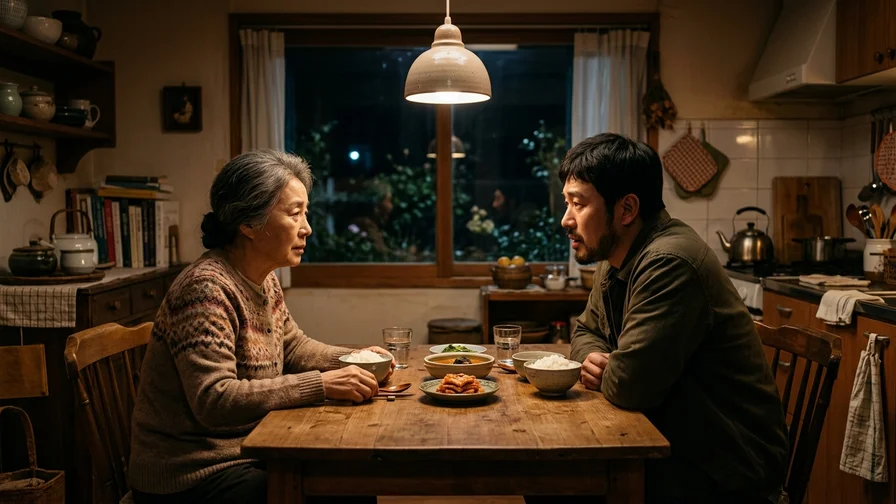
Table-Side Talk and Resolving Conflict: The “Table” as a Space for Connection
In K-dramas, the table goes beyond being a place to eat and serves as a dramatic space where important events unfold and conflicts erupt or are resolved. Serious conversations or major announcements that are hard to make at other times often happen at the table. It’s one of the rare moments when all members gather, and the atmosphere softened by the meal draws out honest conversation.
A Time to Open Up Honestly
In My Mister (tvN, 2018), the scenes where the people of Hugye-dong gather at a neighborhood bar to share drinks and food over a meal are portrayed as moments of tending to one another’s wounds and revealing their deepest thoughts. Warm food and drink have a way of lowering one’s guard, prompting people to speak truths they might never share otherwise. In this way, K-dramas use the table to give characters a chance to confirm each other’s sincerity and reach turning points in their relationships.
A Family Reunited by the Power of the Table
The scene of a family scattered by misunderstanding and conflict gathering around one table and awkwardly beginning to eat is a familiar K-drama cliché. At first, silence hangs in the air, but the moment someone places a piece of side dish onto the other’s bowl, the frozen hearts begin to thaw. The “we’re sorry,” “thank you,” and “we love you” that feel too awkward to say out loud are quietly conveyed over a single meal. The act of eating together carries a message of hope: that any conflict can be overcome and “we” can be whole again.
The Healing the Table Offers in K-Dramas: Warm Comfort and Simple Happiness
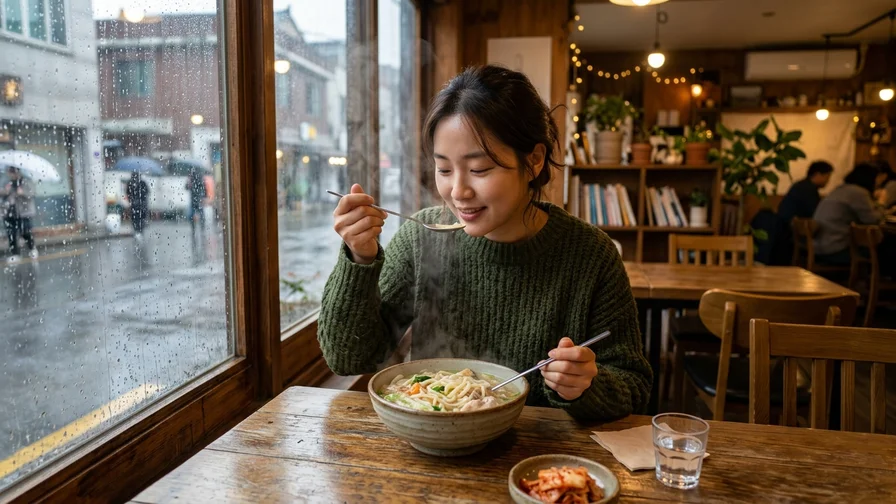
A protagonist worn out by a harsh reality shedding tears while eating a warm home-cooked meal prepared by their mother. The reason so many viewers tear up alongside them is that they relate to the unconditional love and comfort held in that table. The table in K-dramas offers viewers emotional stability and healing as well.
Conveying Love and Worry Through Food
A modest table laid out late at night, full of care, for a protagonist who has had a hard day brings greater comfort than any lavish feast. It’s a representative example of the depth of “jeong (情)” in K-dramas, which expresses the special bond Koreans share. Beyond simply filling the stomach, it conveys the unspoken message of “I worry about you” and “I’m here by your side.”
Small Joys in Everyday Life
K-dramas shine a light not on grand success but on the simple happiness of eating good food with the people you love. Think of scenes like cooking ramyeon with friends, or sharing a bowl of udon with a partner at a street stall on the way home from work. Some dramas put food itself front and center: Let’s Eat (tvN, 2013–2014) became a talking point for its scenes of single neighbors gathering to eat together, the so-called “mukbang” (eating-broadcast) style of direction, showing how the mukbang content culture that began in Korea and has now spread worldwide ties into K-drama meal scenes. The message that true happiness isn’t somewhere far away but lies in the time spent sharing a warm meal is exactly why viewers around the world connect with the table scenes in K-dramas.
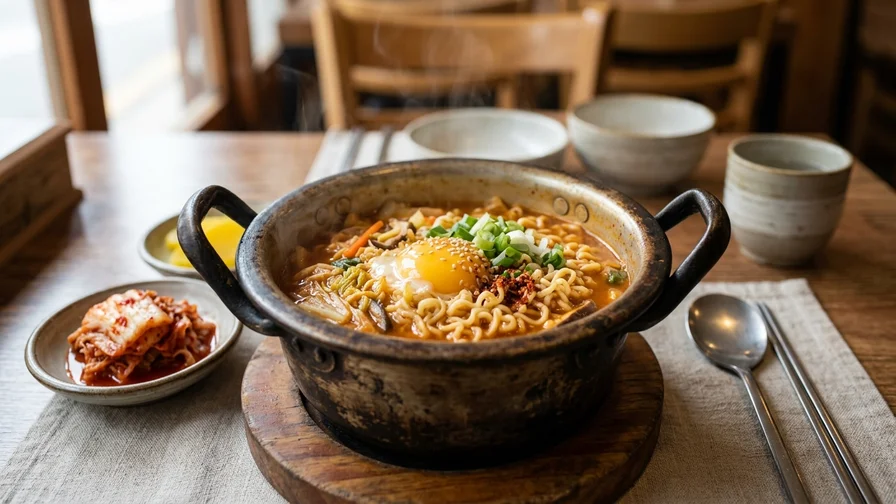
In conclusion, the table in K-dramas is not a mere prop or backdrop but a key symbol that distills Korean emotion, relationships, and community culture. The sight of people sharing their lives over a meal, comforting one another, and finding the strength to rise again resonates deeply regardless of nationality. The next time you watch a K-drama, try to notice the hidden meanings in the food, the conversation, and the glances exchanged at the table. You’ll find deeper stories in Korean values in K-dramas. Find more information at Come On Korea.