Doctors and Nurses in K-Dramas — People Who Stand Before Life Itself
목차
- Medical Staff in K-Dramas: On the Line Between Hero and Human
- On the Front Lines of Life: The Real Struggles and Ethics of Medical Staff
- The Secret Behind K-Medical Dramas’ Global Appeal
- The Korean Healthcare System and Values These Dramas Present
- The Voices of Real Medical Workers: The Gap Between Drama and Reality
- Beyond the Drama: If a Traveler Needs to Use a Korean Hospital
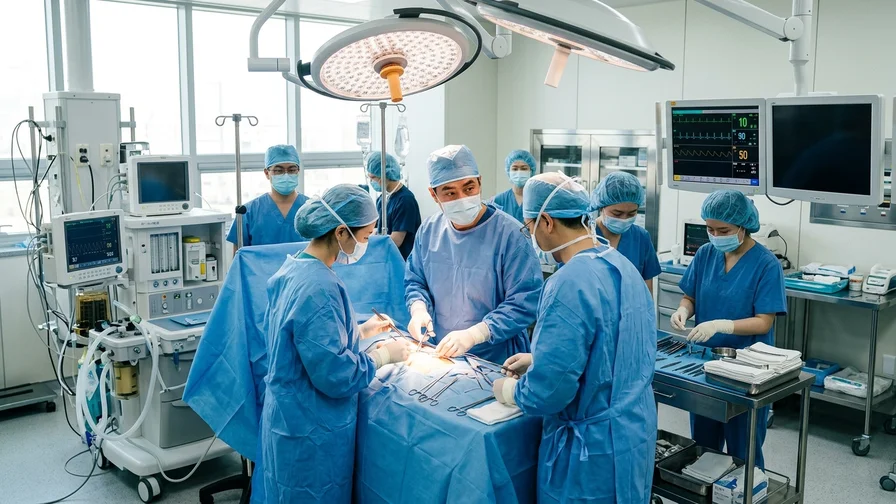
Under the dazzling lights of the operating room, in those tense moments balanced between life and death. Through our TV screens, we have met countless portrayals of medical staff in K-dramas. Sometimes depicted as heroes who work miracles with genius-level skill, and other times as ordinary humans who lean their tired shoulders on one another, they have captured the hearts of viewers around the world. In this article, we look at how K-dramas shine a light on the medical profession, along with the real-world background knowledge about Korea’s healthcare system that you’ll need to truly understand these shows. For a guide that helps you understand the broader world of professions in K-dramas, check out “Exploring Professions in K-Dramas.”
Key Information at a Glance
- Notable medical dramas: Hospital Playlist (tvN, 2020–2021), Dr. Romantic (SBS, Seasons 1–3, 2016–2023), Life (JTBC, 2018), The Trauma Code: Heroes on Call (Netflix, 2025), Resident Playbook (tvN, 2025)
- How doctors are trained in Korea: 6 years of medical school → national medical licensing exam → 1-year internship → 3–4 years as a resident → specialist
- How to watch: Hospital Playlist and The Trauma Code are available on Netflix with multilingual subtitles (as of June 2026)
- Traveler’s note: In Korea, dial 119 for emergencies, and 1330 (24-hour multilingual) for tourist information and interpretation. Note that 1339 is a dedicated line for infectious-disease consultations.
Medical Staff in K-Dramas: On the Line Between Hero and Human
Key Takeaways
- K-dramas portray medical staff in multiple dimensions—as heroes with almost superhuman abilities, and as realistic humans with their own personal struggles and lives.
- The sense of mission in saving lives and the human conflicts that unfold under extreme stress are the core driving forces of these stories.
- The balance between these two faces is what makes viewers empathize deeply with medical staff and reconsider the value of their profession.
The Noble Mission of Doctors Who Save Lives
Medical staff in K-dramas are often portrayed as heroes who save patients’ lives in near-impossible situations. A prime example is SBS’s “Dr. Romantic” (Season 1 in 2016, with the series running through Season 3 in 2023). Master Kim, played by Han Suk-kyu, is a legendary surgeon who leaves a major Seoul hospital to work at Doldam Hospital, a small branch in a rural area. He is the last hope for his patients and a mentor who serves as a guiding light for younger doctors. This kind of heroic narrative delivers intense catharsis while awakening a sense of mission tied to the medical profession.
“The Trauma Code: Heroes on Call,” released on Netflix in January 2025, belongs to the same lineage. It tells the story of genius surgeon Baek Kang-hyuk (Joo Ji-hoon) reviving a trauma team that existed in name only. Right after its release, it topped Netflix’s global rankings for non-English TV shows, once again proving the worldwide competitiveness of K-medical dramas.
Balancing the Struggles and Personal Lives of Medical Staff
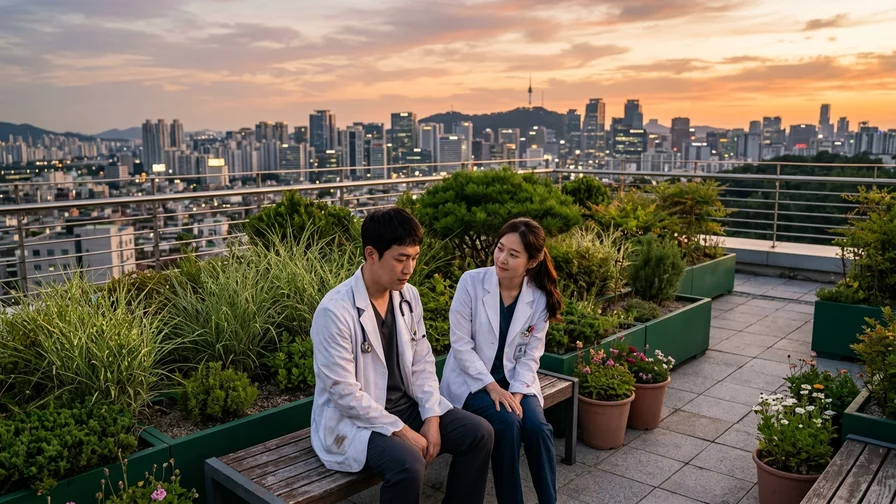
But K-dramas don’t stop at portraying heroes. tvN’s “Hospital Playlist” (2020–2021, through Season 2) is widely credited with opening a new horizon in how medical staff are depicted in K-dramas. Set at Yulje Medical Center, it shows five professors who have been friends since medical school. While they fight hard to save their patients, they also practice in a band together, laugh at their children’s antics, and agonize over love—living lives as ordinary humans. By delicately portraying the personal lives and inner conflicts hidden behind their white coats, the show lets viewers empathize with doctors as “people” who carry warm hearts rather than just cold scalpels.
The show’s popularity carried over into the spin-off “Resident Playbook,” which aired on tvN in April 2025. Set within the same Yulje Medical Center universe, this time the protagonists are not professors but first-year residents in obstetrics and gynecology, taking a head-on look at the trials and growth of junior trainees.
On the Front Lines of Life: The Real Struggles and Ethics of Medical Staff
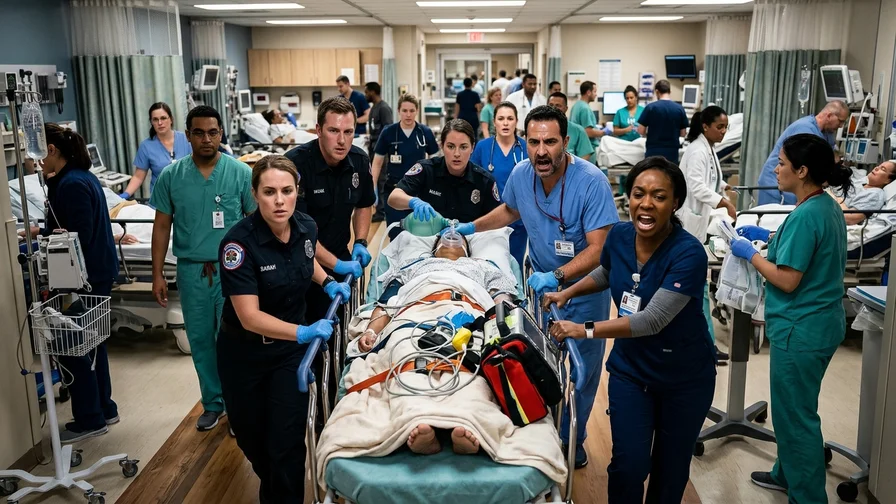
In the medical field, every moment is a series of choices. Amid limited resources, unpredictable variables, and clashing values, medical staff in K-dramas constantly face ethical dilemmas—and this anguish adds depth and realism to the stories.
The Choices and Responsibilities of Medical Staff in Extreme Situations
Dramas set in emergency rooms or trauma centers dramatically convey the weight of these choices. Of two patients whose lives are in danger without immediate surgery, who do you operate on first? The conflict between the principle that all lives should be treated equally regardless of social status, and the hospital’s financial interests, raises the heavy question of “what is justice?” Scenes like these go beyond simple entertainment and can become a catalyst for social discourse. The piece “The Life of a Diplomat in K-Dramas,” which deals with individual struggles within the larger framework of the nation, is also worth reading alongside this.
Memorable Scenes Tackling Medical Ethics Debates
K-medical dramas have taken on sensitive yet socially important topics that society must grapple with—euthanasia, organ transplant priority, the ethics of clinical trials, and internal hospital power struggles. A prime example is JTBC’s “Life” (2018). When an executive from the parent company (Cho Seung-woo) is appointed CEO of a university hospital, the show portrays the hospital not as a simple space for treatment but as a corporation where the logic of capital sharply collides—raising awareness about the commercialization of healthcare. Dramas like these have the power to make viewers look behind the scenes of the medical system and reflect on it together as members of society.

The Secret Behind K-Medical Dramas’ Global Appeal
The popularity of K-medical dramas has expanded beyond Korea to the entire world. Riding global OTT platforms like Netflix, why are so many overseas fans enthralled by the stories of Korean doctors?
Experiencing Korea’s Medical Technology and System Through Drama
Many overseas viewers experience Korea’s medical technology and system indirectly through K-dramas. They glimpse aspects of state-of-the-art surgical equipment, rapid emergency-response systems, and institutions like the National Health Insurance that covers the entire population, forming an impression of Korean healthcare. In fact, just as questions about Korea’s trauma center system poured into overseas communities right after “The Trauma Code” hit No. 1 in Netflix’s non-English category, these dramas function as more than just content—they act as soft power that elevates Korea’s national brand.
Editor’s Tip
If you want to enjoy K-medical dramas on a deeper level, it helps to learn a few medical terms that frequently come up. Just knowing terms like “cardiac arrest,” “laparotomy,” “ICU (intensive care unit),” and “guardian” (a word that appears very often in Korean hospital culture) will double the tension of surgery and ER scenes. Picking up some Korean is a bonus.
Overseas Viewers’ Reactions and the Cultural Ripple Effect of Medical Dramas
On social media and online communities, reactions from overseas fans of K-medical dramas pour in real time. Beyond the characters’ relationships and romances, many viewers say they were deeply moved by the professional ethics and humanity that medical staff in K-dramas display. Comments like “we wish our country had doctors like that” show that the universal values K-dramas convey are exerting their influence across borders.

The Korean Healthcare System and Values These Dramas Present
K-dramas are also a window into Korea’s healthcare system and the values embedded within it. To understand these shows more accurately, some background knowledge about how doctors are trained in Korea is useful.
Background Knowledge to Understand the Dramas: How Doctors Are Trained in Korea
- 6 years of medical school: 2 years of premed plus 4 years of the main medical program. In Korea, medical school is a classic gateway reserved for top-scoring students, which is why a line like “got into med school” instantly signals an elite narrative in dramas.
- National medical licensing exam: After graduating from medical school, passing this exam earns a doctor’s license.
- 1-year internship: Rotating through various clinical departments for training. These are the lowest-ranking doctors in the dramas.
- 3–4 years as a resident: The stage of training in a single chosen specialty. The protagonists of “Resident Playbook” fall into this category. This is the period where night shifts and grueling workloads are heavily depicted.
- Specialist: Earned after completing residency and passing the specialist board exam. Like the five protagonists of “Hospital Playlist,” university hospital professors are veterans who have gone through subsequent stages such as a fellowship.
Once you understand this ladder, the characters’ coat colors, titles (“Professor,” “Doctor”), and power dynamics read in a far more three-dimensional way.
The Tension Between Public Values and Hospital Management Logic
A recurring conflict structure in K-medical dramas is the clash between “the doctor who prioritizes life” and “hospital management that calculates profit.” Doldam Hospital in “Dr. Romantic” is portrayed as a space that resists the efficiency-driven logic of the foundation’s main hospital, while “Life” puts the confrontation between the corporation holding management rights and the doctors front and center. These narratives reflect Korean society’s ongoing debate over what “good healthcare” really means. Official information about Korea’s healthcare policies and institutions can be found at the Ministry of Health and Welfare.
A Patient-Centered Medical Culture and the Emphasis on Benevolent Medicine
One of the biggest characteristics of K-medical dramas is the emphasis on “insul” (仁術), the art of benevolent medicine. It means practicing medicine not merely as a technique to treat illness, but with a heart that loves people and treats them with kindness. The doctors in these dramas empathize with their patients’ pain and strive to care for their lives as a whole. This warm, patient-centered medical culture prompts us to reflect on what values we must not lose in an age dominated by technology.
The Voices of Real Medical Workers: The Gap Between Drama and Reality
So how do actual medical workers view their on-screen counterparts? Dramas reflect reality, but there are certainly parts that get exaggerated or idealized for dramatic effect.
Current Medical Workers on the Pros and Cons of These Dramas
Many practicing doctors highly value how dramas instill a positive perception of doctors and awaken people to the preciousness of life. At the same time, there is regret over unrealistic setups. Scenes where a single doctor crosses between surgery, internal medicine, and emergency medicine to treat every patient, or performs flawless surgery after staying up for several nights straight, are far removed from reality. This is the gap between the fantasy of dramas and reality.
The Role of Dramas in Improving the Medical Environment
Even so, dramas play an important social role, because they help bring real-world problems into public discussion—poor training conditions for residents, verbal abuse and assault against medical staff, and personnel shortages in essential medical fields. In fact, in Korea, the government and the medical community were locked in a prolonged standoff in early 2024 over a plan to expand medical school enrollment (the so-called doctor-government conflict), during which many residents left their hospitals, before a significant number returned to training in the second half of 2025 amid the turmoil. Just as a drama about the daily lives of residents aired during this period and raised public interest in training conditions, the sense of empathy formed through dramas can become a long-term driving force for improving the medical environment.
Beyond the Drama: If a Traveler Needs to Use a Korean Hospital
Here is some basic information that foreign travelers who have encountered Korean healthcare through dramas should know if they actually get sick or injured in Korea. (As of June 2026)
- For emergencies, dial 119: This number handles both ambulance dispatch and emergency medical consultations. If you need a foreign language, you’ll be connected via a three-way interpreter, and there’s also a way to reach 119 together with an interpreter through the SOS button in the 1330 app.
- For tourist information and interpretation, dial 1330: A 24/7 phone line operated by the Korea Tourism Organization, offering consultations in multiple languages including English, Japanese, and Chinese. You can also get help such as directions to hospitals or pharmacies.
- 1339 is dedicated to infectious-disease consultations: Some older guide materials still list 1339 as an emergency medical consultation number, but currently 1339 is a line dedicated to infectious-disease consultations run by the Korea Disease Control and Prevention Agency. For emergency medical care, you should dial 119.
- Treatment in foreign languages: Many major university hospitals in Seoul operate international healthcare centers for foreign patients, where you can book appointments with English-speaking care. The most accurate approach is to confirm by phone or email with the hospital’s international healthcare center before your visit.
- Travel insurance: Korea’s National Health Insurance does not apply to short-term travelers, so it is recommended to purchase travel insurance that covers medical expenses before departure.
In conclusion, medical staff in K-dramas are more than just an occupational group—they are powerful messengers that convey universal values such as respect for life, social responsibility, and humanity. If you’d like to learn more about the various professions that appear in K-dramas, gain a broader perspective through our comprehensive guide, Exploring Professions in K-Dramas. And whenever you need more information about Korea’s diverse culture and trends, come visit Come On Korea anytime.