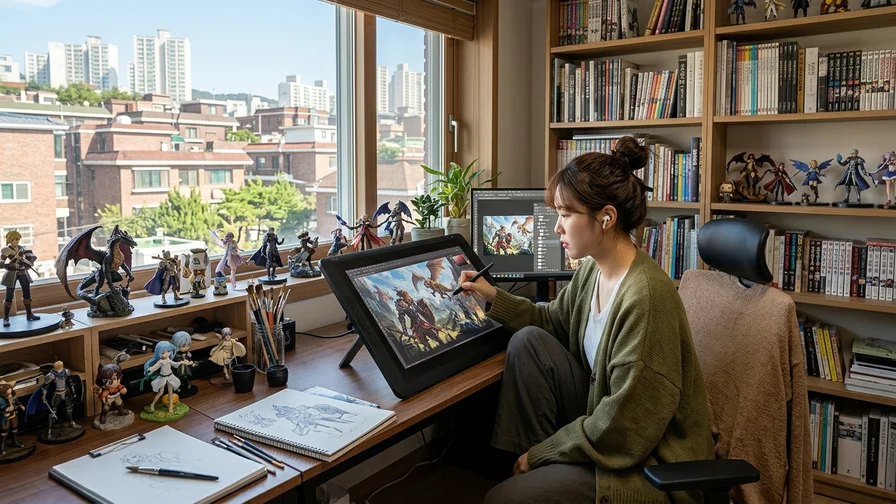
Webtoon Artists in K-Dramas — The Creative World Behind the Blank Page
목차
- Webtoon Artists in K-Dramas: A Bridge Connecting Imagination to Reality
- The Evolution of Korean Webtoons and Their Spread as Global K-Content
- A Webtoon Artist’s Creative Process and Struggles: The Birth of a Story
- Webtoon-Based Dramas: Matching Works, Creators, and Platforms
- 3 Places Webtoon Fans Can Visit in Person
- The Future of the Webtoon Industry: New Horizons Alongside K-Dramas
Key Takeaways
- The dramas that put webtoon artists and the webtoon industry front and center are “W” (MBC, 2016) and “Today’s Webtoon” (SBS, 2022) — every drama and original webtoon cited here has been verified down to the creator’s name, serialization platform, and broadcast year.
- Korea’s webtoon industry posted revenue of KRW 2.2856 trillion in 2024 (Ministry of Culture, Sports and Tourism; Korea Creative Content Agency, “2025 Webtoon Industry Survey”). Naver Webtoon’s global service is branded “WEBTOON,” and its parent company, WEBTOON Entertainment, went public on the Nasdaq in June 2024, while Kakao is pushing into global markets through Japan’s “Piccoma” and North America’s “Tapas.”
- Three places webtoon fans can visit in person in Korea — Jaemiro in Myeongdong, Kangfull Cartoon Street in Gangdong-gu, and the Korea Manhwa Museum in Bucheon — are summarized with transit directions and operating details (as of June 2026).
As K-dramas have captivated the world, we’ve peeked through our screens into the worlds of doctors, lawyers, chefs, and many other professions. And now there’s a profession getting fresh attention: the webtoon artists in K-dramas who create the source stories behind K-content. This article covers the lives of webtoon artists as dramas depict them, the real scale of Korea’s webtoon industry according to official statistics, accurate matches between dramas and their original webtoons, and even the places webtoon fans can walk through on a trip to Korea. If you’re curious about the broader context of various K-drama professions, start by reading “Exploring Jobs in K-Dramas.”
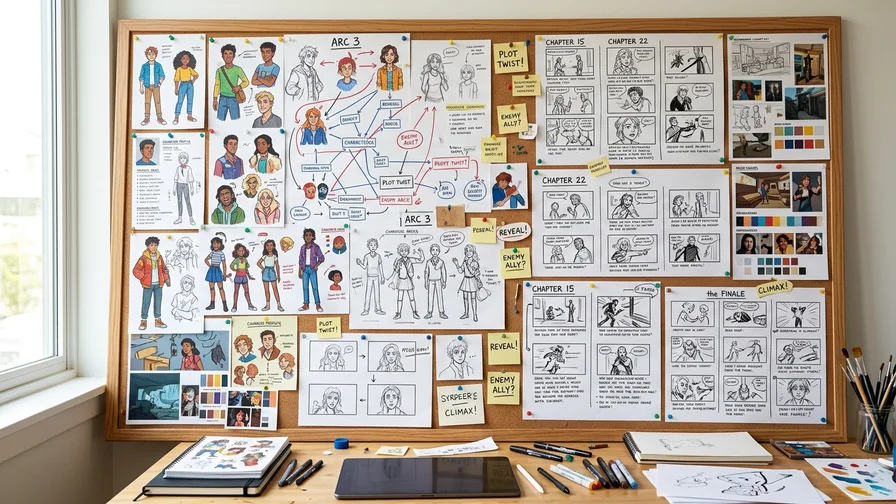
Webtoon Artists in K-Dramas: A Bridge Connecting Imagination to Reality
Two real dramas stand out for tackling webtoon artists and the webtoon industry head-on.
- “W” (MBC, 2016): Kang Cheol (Lee Jong-suk), the protagonist of a webtoon drawn by popular artist Oh Seong-moo (Kim Eui-sung), leaps out into the real world, while the artist’s daughter Oh Yeon-joo (Han Hyo-joo) gets pulled into the webtoon world in reverse. The drama squarely poses the question of the relationship between artist and character — and “how far is a creator responsible for the world they’ve made?”
- “Today’s Webtoon” (SBS, 2022): A coming-of-age story about On Ma-eum (Kim Sejeong), a former judo athlete who joins a webtoon company as a rookie PD (editor). A remake of the Japanese manga “Sleepeeer Hit!” (“Juhan Shuttai!”), it’s a rare and valuable work that reveals the behind-the-scenes of the webtoon industry — not just artists, but the editors who keep deadlines rolling alongside them and the platform operators too.
One thing to set straight. Many articles introduce “True Beauty” (tvN, 2020–2021) and “Our Beloved Summer” (SBS, 2021–2022) as webtoon-artist dramas, but that’s inaccurate. “True Beauty” is simply a drama based on the Naver Webtoon by the artist Yaongyi, and its protagonist is a high schooler; meanwhile, Choi Ung (Choi Woo-shik) in “Our Beloved Summer” is an illustrator who draws buildings, not a webtoon artist.
A Webtoon Artist’s Life: Less Glamorous Success, More Weekly Deadlines
The dramas realistically capture the struggles hidden behind a webtoon artist’s success — all-nighters, slumps when ideas run dry, and the pressure of readers’ real-time comment reactions. The actual figures back this up: according to the Korea Creative Content Agency’s “2024 Webtoon Industry Survey,” the median annual income of artists who serialized work year-round was about KRW 38 million, a wide gap between the glamour of the star artist in dramas and the average reality. The weekly serialization system, which requires posting a set amount each week, is both a source of Korean webtoons’ competitiveness and the biggest burden artists cite.
The Appeal of Webtoons, Where Imagination Becomes Reality
K-dramas showcase the medium’s potential through the process of a webtoon artist’s imagination being visually realized on screen. A prime example is “W,” where the webtoon’s world shifts and characters come to life at the tip of the artist’s pen. These are scenes that show webtoons are more than mere comics — they’re a storytelling medium with fully realized worlds of their own.

The Evolution of Korean Webtoons and Their Spread as Global K-Content
Today’s webtoons weren’t built overnight. They started in the early 2000s as an alternative to the print comics market, riding the spread of the internet, and grew into a massive industry as vertical-scroll formatting and weekly serialization meshed perfectly with the mobile era’s content-consumption habits.
Korea’s Webtoon Industry by the Numbers
- Korea’s webtoon industry revenue in 2024 was KRW 2.2856 trillion, up 4.4% year over year (Ministry of Culture, Sports and Tourism; Korea Creative Content Agency, “2025 Webtoon Industry Survey,” released December 2025).
- After surpassing KRW 2 trillion in revenue for the first time ever in 2023 (KRW 2.189 trillion), the industry has continued its growth.
- Export share breaks down as follows: Japan 49.5%, North America 21%, Greater China 13%, Southeast Asia 9.5%, and Europe 6.2%.
The full report is available to anyone on the Korea Creative Content Agency (KOCCA) official site.
A Guide to Global Service Names by Platform
Here’s a rundown of the service names overseas readers often find confusing when looking for Korean webtoons.
- Naver Webtoon: Its global service is named WEBTOON (offering official translations in English and other languages), and in Japan it operates as “LINE Manga.” Its parent company, WEBTOON Entertainment, listed on the U.S. Nasdaq in June 2024 (ticker WBTN).
- Kakao: In Korea it operates as KakaoPage and Kakao Webtoon; in Japan as “Piccoma” (a top-ranking manga app by revenue since 2020, surpassing JPY 100 billion in annual transaction volume in 2023); and in North America as “Tapas.”
By continually expanding genres beyond romance, fantasy, and thrillers into social commentary and historical works, the key factor behind their global success is that deep narratives reflecting the realities of Korean society have won universal empathy across borders.
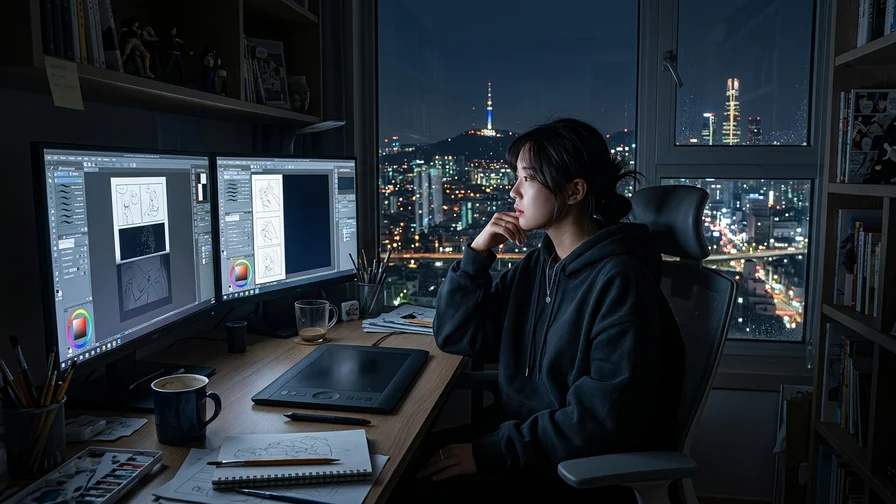
A Webtoon Artist’s Creative Process and Struggles: The Birth of a Story
K-dramas vividly portray the fierce creative process of webtoon artists beyond the finished product that readers see. As you can also glimpse in the life of diplomats in K-dramas, this kind of inner conflict within a profession is a device that adds depth to the drama by exploring the struggles of a specific occupational group.
From Idea to Serialization: Everything About Making a Webtoon
Dramas compress the entire production process — starting from capturing an idea, then building a synopsis, designing characters, drawing storyboards, sketching, coloring, and meeting the deadline. Recently, there’s also been a trend toward realistically depicting how technological changes, such as digital drawing tools and 3D background assets, affect the creative process.
Slumps and Deadline Pressure: A Webtoon Artist’s Hidden Pain
Slumps when ideas dry up, health problems from sitting and working for long hours, and the mental stress of malicious comments. Dramas show, without sugarcoating, the shadows hidden behind the joy of creation, giving viewers a multidimensional understanding of the webtoon artist profession.
Editor’s Tip
Watching while comparing the original webtoon and the drama is the way to enjoy this genre twice as much. On Naver Webtoon’s global service WEBTOON, you can read originals like “Sweet Home” and “True Beauty” in official English translation. If you watch the drama first and then look for differences in the adaptation (cut characters, changed endings) in the original, you’ll see the choices the webtoon artist and the screenwriter each made. It’s also interesting to compare with cases like “Moving,” where the original creator personally wrote the drama’s script.
Webtoon-Based Dramas: Matching Works, Creators, and Platforms
It’s no exaggeration to say webtoons are now the “story pantry” of K-dramas. Here’s a rundown of major webtoon-based hit dramas along with their original creators and serialization platforms.
| Drama (Channel, Aired) | Original Webtoon Artist | Original Serialization Platform |
|---|---|---|
| Misaeng (tvN, 2014) | Yoon Tae-ho | Daum Manhwa Sokesesang (now Kakao Webtoon) |
| Itaewon Class (JTBC, 2020) | Gwangjin | Daum Webtoon (now Kakao Webtoon), serialized 2017–2018 |
| Sweet Home (Netflix, 2020–2024) | Story by Kim Carnby, art by Hwang Young-chan | Naver Webtoon, serialized 2017–2020 |
| True Beauty (tvN, 2020–2021) | Yaongyi | Naver Webtoon |
| Yumi’s Cells (tvN, 2021–2022) | Lee Dong-gun | Naver Webtoon |
| Moving (Disney+, 2023) | Kangfull | Serialized on Daum Webtoon (2015), now KakaoPage |
The Visual Strengths of Webtoons and Their Synergy with Dramas
Webtoons imprint a character’s image and a story’s mood on readers through their already-finished artwork and direction. In drama production, this serves as an excellent “visual storyboard,” and a story and fandom already proven through webtoons act as factors that reduce box-office risk. “Moving” is a case where the original creator Kangfull personally wrote the script to reinforce the character backstories that couldn’t fit into the webtoon, and right after its release it topped the TV show category on Disney+ in Korea, Japan, Hong Kong, Singapore, and Taiwan.
The Cultural Ripple Effect of the Webtoon–Drama Virtuous Cycle
A successful drama adaptation, in turn, brings readers back to the original webtoon. It’s a virtuous cycle where viewers who first encounter a work through a drama go on to read the original, energizing the entire webtoon market. This “one source, multi-use (OSMU)” strategy maximizes the value of webtoon IP — a prime example being “Itaewon Class,” which went beyond a drama to be staged as a musical in Japan in 2025.
3 Places Webtoon Fans Can Visit in Person
If you’ve fallen for Korean comics through dramas and webtoons, here are places you can walk through yourself in Seoul and the surrounding metro area. Operating details are as of June 2026.
Jaemiro — A Comic Street in the Heart of Myeongdong
Jaemiro is a roughly 450-meter comic-themed street that runs from in front of Exit 3 of Myeongdong Station (Subway Line 4) toward Namsan. Created by the Seoul city government in 2013, it’s decorated with works by Korean comic artists on building walls, retaining walls, stairways, and even utility poles. Since the street itself is free and open, it’s easy to naturally fit into a Myeongdong shopping or Namsan walking route.
Kangfull Cartoon Street — The Alley of the “Moving” Creator
A mural alley themed around the works of Kangfull, the original creator of “Moving.” It’s located in a residential area of Seongnae-dong, Gangdong-gu, Seoul, and is within walking distance of Exit 4 of Gangdong Station (Subway Line 5). Scenes from works like “Pure Love” and “we Love You” are painted across ordinary alley walls and pavement, and a “Moving” sculpture was added in 2022. Kangfull Cartoon Street is free and open.
Korea Manhwa Museum — A Century of Korean Comics in One Place
The Korea Manhwa Museum in Bucheon, Gyeonggi Province, is the nation’s leading comics museum, covering the history of Korean comics from print to webtoons. It’s about a 1-minute walk from Exit 5 of Samsan Gymnasium Station (Subway Line 7). Viewing hours are 10:00–18:00 (last admission at 17:00), and it’s closed every Monday, on January 1, and during the Lunar New Year and Chuseok holidays. General admission is KRW 5,000 (as of June 2026). Check the latest exhibitions and prices on the Korea Manhwa Museum official site.
The Future of the Webtoon Industry: New Horizons Alongside K-Dramas
The webtoon industry is strengthening its symbiotic relationship with K-dramas and preparing for its next leap. As AI tools such as automatic background generation and coloring assistance enter the production environment, an environment is being created where artists can focus on core creative work. And riding the local-language translation and marketing of global platforms like WEBTOON, Piccoma, and Tapas, K-webtoons are moving beyond a niche subculture to establish themselves as mainstream content. The webtoon artist of the future will be less just someone who draws and more akin to a creative director who understands technology and works on the stage of the global market.
In conclusion, webtoon artists in K-dramas are more than mere drama characters — they’re icons symbolizing the dynamism and future of Korea’s content industry. It’s because of their imagination and passion that K-content’s stories never stop. If you’d like to explore the world of K-drama professions more deeply, check out more stories in our comprehensive Exploring Jobs in K-Dramas guide. Find more information at Come On Korea.