Following K-Drama Baristas to the Coffee and Filming-Location Cafes
목차
- Coffee and Baristas in K-Dramas: More Than Just a Drink
- The Barista’s Craft and Artistry: The Effort Behind Every Cup
- The Evolution of K-Café Culture: Trends and Spaces the Dramas Drove
- Your Own K-Drama Café Tour: Following in a Barista’s Footsteps
- Balancing the Real Barista’s Life with the Drama Fantasy
If you watch enough K-dramas, certain scenes just stay with you. Think of those moments when the leads sit in a café and share their feelings over a single cup of coffee. And right there beside them, quietly pulling shots and watching the story unfold, is a familiar figure: the K-drama barista. They’re more than just someone who makes drinks. Sometimes they’re a counselor, sometimes the helper who sets the whole plot in motion. In this article, we’ll look at how K-dramas have portrayed the barista as a profession, and which filming-location cafés you can actually visit (and which ones to skip) in 2026, based on verified information.
For more stories about the many jobs that appear in K-dramas, check out our The Jobs in K-Dramas — Reading Korean Society Beyond the Screen.
Key Takeaways
- It all started with Coffee Prince (2007): The first mega-hit to put baristas and a café front and center, peaking at a 27.8% viewership rating. That said, the Hongdae filming-location café shut down around 2020, so today you’ll only find an empty building.
- The café Hallyu wave dramas created: The café product placement in Descendants of the Sun and Goblin was so powerful that franchise inquiries jumped 170–200% within a single month.
- Real skill beyond the fantasy: In 2019, a Korean barista became world champion, turning the drama’s “best barista” storyline into reality. Every café on this list was confirmed to be open as of June 2026.
Coffee and Baristas in K-Dramas: More Than Just a Drink
In K-dramas, cafés aren’t just background. They’re the stage where the story plays out — meetings and farewells, conflict and reconciliation — and at the center of it all is the barista. Through coffee, they give voice to the characters’ emotions, and sometimes they offer more comfort in silence than any words could.
The Original Barista Drama: Coffee Prince
- Aired on MBC in 2007, starring Gong Yoo and Yoon Eun-hye. A mega-hit that peaked at a 27.8% viewership rating.
- A romance between a young woman who disguises herself as a man to work at a café and her café-owner boss — it’s considered the first drama to seriously put a barista’s daily life on screen, from choosing beans to pulling espresso shots to running the café itself.
- After it aired, it sparked a café-startup boom in Korea and popularized the very job title of “barista.”
- A note on the filming location: The real café near Hongdae kept the drama’s set intact and ran for over a decade as a pilgrimage spot for fans — but it closed between late 2019 and early 2020. As of 2025 reporting, the building still sits empty, so you can’t even get a cup of coffee there now. Don’t waste the trip (as of June 2026).
The Comfort and Empathy K-Drama Baristas Offer
- A worn-out protagonist finding comfort in a cup of coffee made by a barista is a classic K-drama trope.
- The barista is portrayed as a careful observer who can read a customer’s mood just from their expression and quietly hand over exactly the drink they need.
- This reflects the value Korean society places on jeong (a deep sense of affection and connection) — it shows genuine human warmth rather than mere service. Coffee itself becomes a device that symbolizes a character’s personality: a meticulous pour-over for the demanding lead, a bold signature drink for the free spirit.
The Barista’s Craft and Artistry: The Effort Behind Every Cup
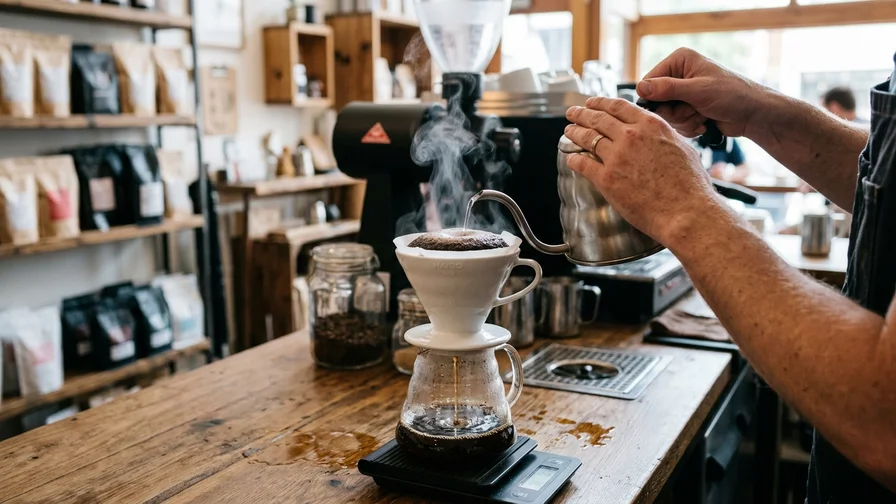
K-dramas don’t just romanticize baristas — they also give real weight to the expertise and craftsmanship behind the scenes. From selecting green beans to roasting tailored to each bean’s character, to dialing in grind size and extraction time, the dramas show that a barista isn’t just someone who makes coffee, but a scientist and artist who draws out a bean’s full potential.
Real Skill Off-Screen: The Country That Produced a World Champion
- The “best barista” storyline isn’t an exaggeration. In April 2019, barista Jeon Joo-yeon of Momos Coffee📍 in Busan became the first Korean to win the World Barista Championship (WBC), held in Boston, USA.
- Korea has no government-issued barista certification. The system runs on private certifications (Level 1 and Level 2) issued by bodies like the Korea Coffee Association, along with international SCA (Specialty Coffee Association) credentials. If you’re curious about the qualifications and training courses, you can find details on the Korea Coffee Association’s official website.
- The “barista devoted to their beans” that dramas portray is a character that grew right alongside this rising specialty coffee scene.
Latte Art and Pour-Over: Visual Delight and Craftsmanship
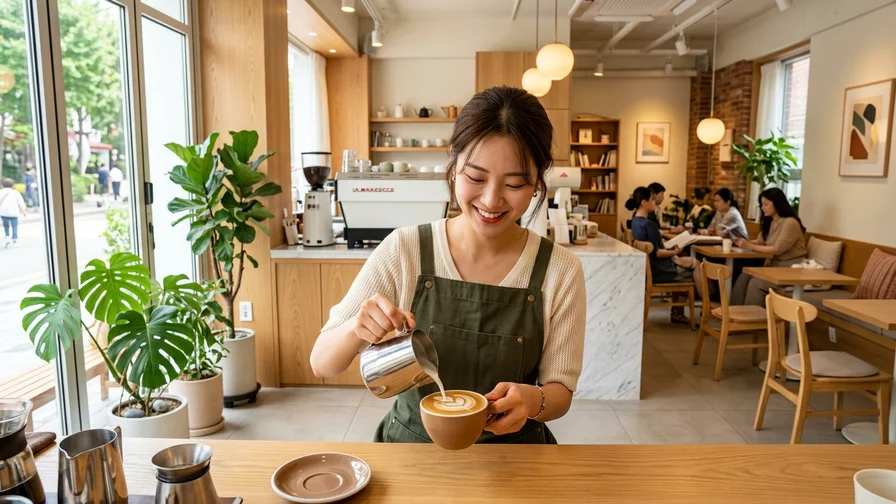
- Latte art — drawing hearts or rosettas in milk foam — is the technique that best showcases a barista’s artistic sense, and dramas love to capture this handwork in close-up.
- Pour-over scenes, slowly streaming water through the grounds, reveal the beauty of patience and care poured into a single cup, tying neatly into Korea’s slow-life trend.
- For another professional world that demands artistic sensibility and expertise, take a look at the world of art in K-dramas.
The Evolution of K-Café Culture: Trends and Spaces the Dramas Drove
K-dramas have played a big role in bringing global attention to Korean café culture. The numbers make it even clearer.
- According to Statistics Korea, there were 100,729 coffee shops nationwide at the end of 2022 — crossing the 100,000 mark for the first time. That’s more than the number of convenience stores.
- That’s nearly double the roughly 51,000 shops in 2016, in just six years.
- An example of product placement’s ripple effect: when Descendants of the Sun (2016) aired, franchise inquiries for dal.komm coffee, which appeared in the show, rose about 170% month over month and led to a first location in Singapore. With Goblin (2016–17), inquiries jumped over 200%, with overseas interest surging from Vietnam, Thailand, and beyond.
Touring the Aesthetic Cafés Made Famous as K-Drama Filming Locations
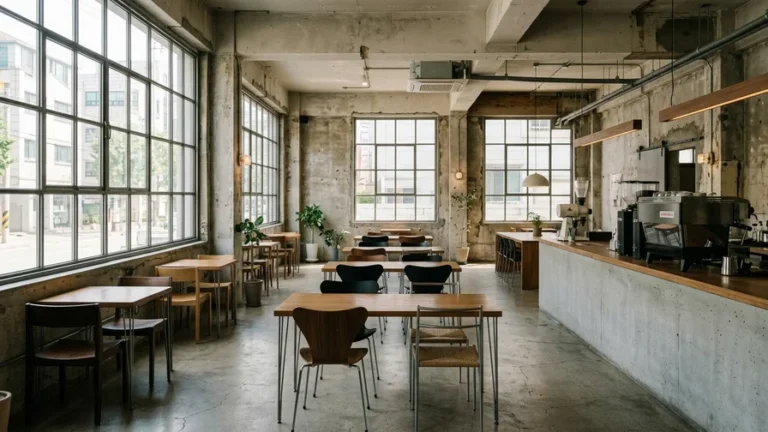
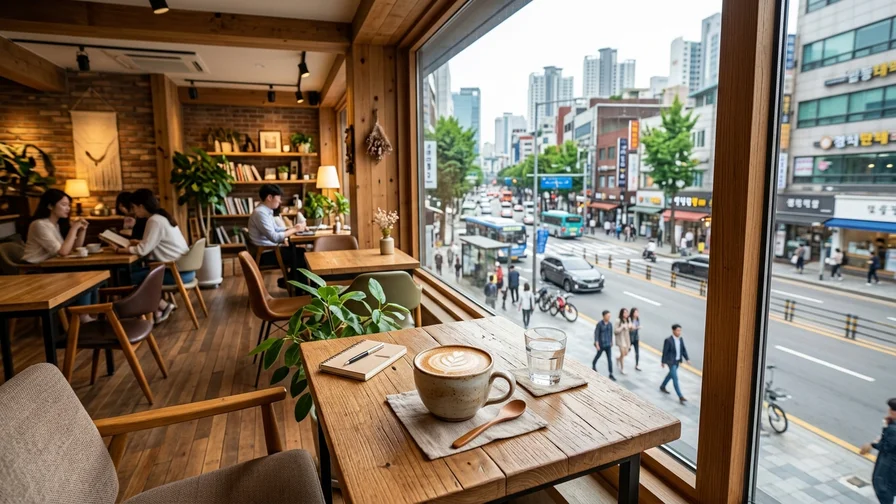
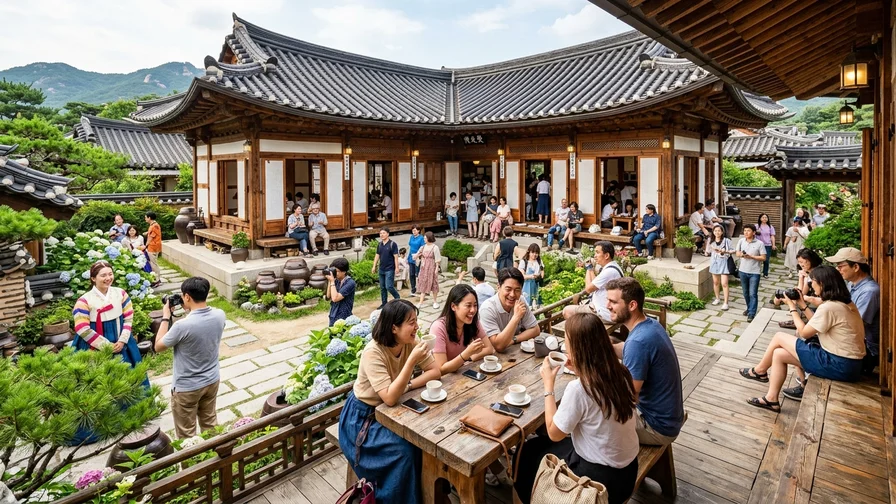
Many K-drama fans put cafés that look straight out of a scene at the top of their must-do list when traveling to Korea. The most iconic types are serene hanok-style cafés converted from traditional houses, and industrial cafés remodeled from factories and warehouses. Spots like Onion Anguk and Daelim Changgo in Seoul were popular even before any media exposure, but rode dramas and social media to become global hotspots.
The Rise and Popularity of Drama-Themed Cafés
- Themed cafés and pop-ups built around a specific drama’s concept keep appearing. They might recreate a drama’s fictional café or work props and famous lines into the interior and the menu.
- However, most of these spaces are temporary pop-ups that operate only during the broadcast period. Always check the official social media before visiting — many have already closed by the time the show wraps.
Your Own K-Drama Café Tour: Following in a Barista’s Footsteps
If a K-drama got you hooked on Korean café culture, it’s time to experience it for yourself. Below is a list of places confirmed to be open as of June 2026.
The Drama Coffee Trail: A Verified Café List
| Café | Drama Connection | How to Get There and What to Note |
|---|---|---|
| dal.komm (formerly dal.komm coffee)📍 | Descendants of the Sun, Goblin (product placement) | A nationwide franchise, so super accessible. The brand now goes by “dal.komm,” and also runs a robot-barista café called “b;eat.” Find the nearest location with a map search. |
| Onion Anguk📍 | The defining example of the drama-style hanok café mood | 5 Gyedong-gil, Jongno-gu, Seoul. A 1-minute walk from Exit 3 of Anguk Station (Line 3). A bakery café in a converted hanok, open 07:00 on weekdays and 09:00 on weekends, closing at 22:00 (as of June 2026; check the official Instagram before visiting). |
| Daelim Changgo📍 | A pioneer of the industrial café scene | Seongsu-dong, Seoul — about a 5-minute walk from Seongsu Station (Line 2). A 1970s rice mill that became a warehouse and then transformed into a gallery café. Open daily 11:00–22:00 (as of June 2026). |
On the flip side, it’s worth knowing where not to go — the Hongdae filming-location café from Coffee Prince has closed, leaving only an empty building. Some older travel guides still list it as a landmark, so be careful.
Editor’s Tip
Cafés known as filming locations tend to be relatively quiet on weekday mornings, making for a more relaxed visit. The surest way to avoid a wasted trip is to make a habit of checking each café’s official social media for hours and temporary closures before you go. Korea’s trendy cafés open, move, and close often, so don’t take blog posts that are one or two years old at face value.
Barista Class Experiences: Make Your Own Drama-Worthy Coffee
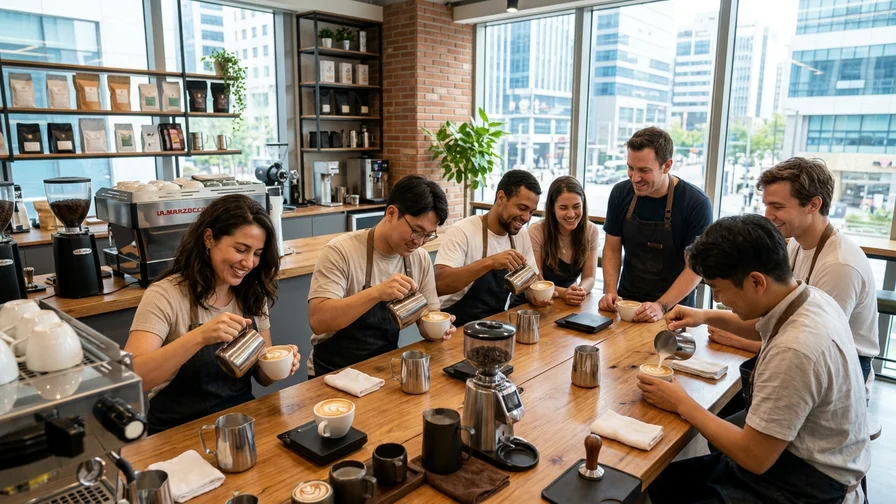
- If you want to go beyond drinking coffee and make it yourself, try one of the one-day barista classes held around Seoul. You can learn the basics of pour-over and latte art from a professional barista.
- Prices run roughly 50,000 to 100,000 KRW per person depending on the class (as of June 2026; it varies by class). Search “barista class Seoul” on online activity booking platforms like Klook to find classes aimed at international visitors.
Balancing the Real Barista’s Life with the Drama Fantasy
Of course, the way K-dramas portray baristas differs from reality, since dramas tend to play up the romantic side of the job.
- Reality check: The flip side of the 100,000-café era is that roughly 12,000 cafés closed in 2023 alone (per the Ministry of the Interior and Safety). That’s how fiercely competitive the market is.
- Even so, the dramas have clearly helped raise the social standing of the barista profession and build a culture that respects the craft.
- Since Coffee Prince, more young people have dreamed of becoming baristas, and as the public’s coffee knowledge has grown, the ground has been laid for independent cafés offering specialty coffee and original menus to thrive.
- The storyline of a protagonist growing through hardship shows that this job requires as much understanding of people, passion, and perseverance as it does technical skill — and as that 2019 WBC win proves, that growth story is something actually happening in Korea’s coffee scene.
In the end, the K-drama barista is more than just a character — they’re a cultural ambassador conveying Korea’s dynamic coffee culture and its warm emotional sensibility. The delicate skill and the stories held within a single cup of coffee have become a powerful draw, making viewers around the world want to experience Korea more deeply. If you’re curious about in-depth stories of other professions in K-dramas, explore our full The Jobs in K-Dramas — Reading Korean Society Beyond the Screen.