Chewy Jokbal and Bossam — Where to Eat in Jangchung-dong and Jongno
목차
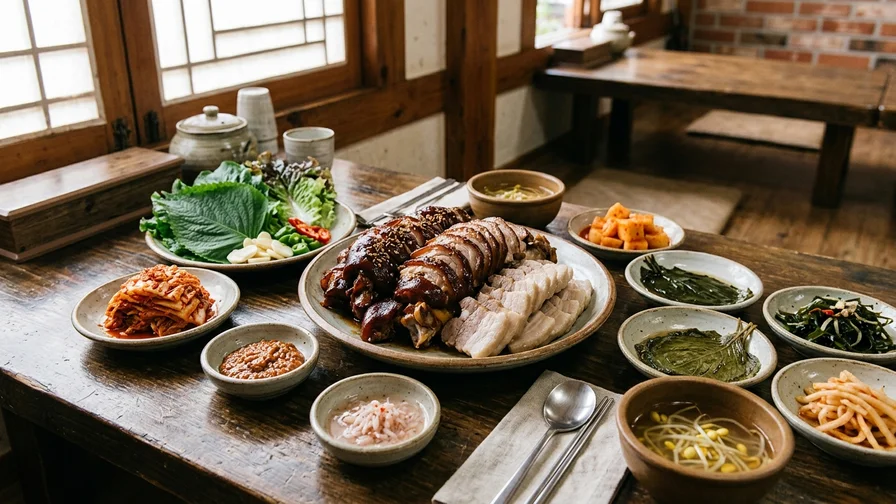
Many foreign travelers see the literal translation “Jokbal — pig’s feet” on a menu and simply skip past it. But jokbal isn’t just the tip of the foot; it’s the whole thing, from the trotter up to the shank, braised for hours in a broth of soy sauce and medicinal herbs. If you’ve enjoyed Germany’s Schweinshaxe (roasted pork knuckle) or Eisbein (boiled pork knuckle), this is a cut that won’t feel unfamiliar at all. Bossam is the same pig boiled in plain water with a doenjang (soybean paste) base instead of soy sauce, served as boiled pork that you wrap together with kimchi. This guide to Korean jokbal and bossam walks you through two Seoul neighborhoods, Jangchung-dong and Jongno, where you can experience both dishes properly, along with the trusted old shops and how to order.
Key Points at a Glance
- Jokbal: Pig’s trotters and shank braised in a broth of soy sauce and medicinal herbs. Recognizable by its deep brown glossy exterior and chewy, gelatinous skin
- Bossam: Boiled pork (pork neck or belly) paired with bossam kimchi. Not braised in soy sauce, so the meat stays pale and mild
- Where: For jokbal, Jangchung-dong Jokbal Street (Dongguk University Station); for bossam, the Jongno 3-ga bossam alley
- Budget: A medium-sized jokbal runs 38,000–40,000 won and is plenty for 2–3 people. Some shops offer a single-portion set (19,000 won)
- Information as of: Prices, hours, and closing days in this article were verified as of June 2026. They may change, so it’s worth checking again before you go
The Basics: Jokbal and Bossam
Jokbal
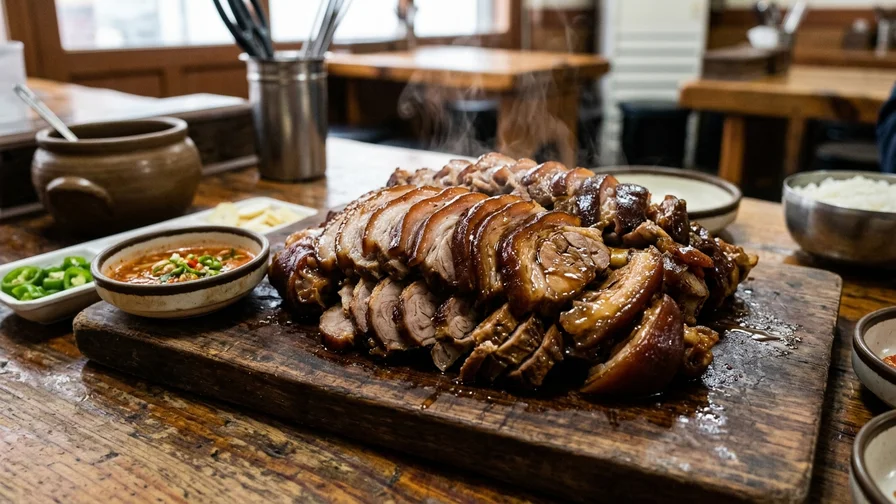
Jokbal is made by slow-simmering a pig’s front or hind leg for a long time in a special broth of medicinal herbs, ginger, garlic, and soy sauce. It helps to know what it looks like when it arrives at the table: the soy broth gives it a deep brown sheen, the skin is springy like gelatin, and the meat is deboned and sliced into thick pieces. The dark color may give you pause at first, but the key is that the long braising removes the pork’s distinctive smell and infuses it with deep flavor. The skin is rich in collagen and has a chewy texture, while the lean meat is tender. It’s usually dipped in saeujeot (salted shrimp) or eaten wrapped in a leaf.
Bossam
Bossam is boiled pork (suyuk, boiled pork slices) made from pork neck or belly simmered with aromatics like doenjang, onion, and garlic (depending on the home or shop, coffee or medicinal herbs may also be added to cut any gaminess). Unlike jokbal, which is braised in soy sauce, the meat is boiled without seasoning, so it stays pale and mild. The classic way to eat it is to wrap thin slices of meat together with bossam kimchi or musaengchae (spicy radish salad) in a salted cabbage leaf or lettuce.
Jokbal vs. Bossam at a Glance
| Category | Jokbal | Bossam |
|---|---|---|
| Cooking method | Braised in a soy sauce and medicinal-herb broth | Boiled in plain water with a doenjang base |
| Cut | Front or hind leg (trotter to shank) | Pork neck or belly |
| Appearance and texture | Deep brown, chewy skin with tender meat inside | Pale meat, mild and moist |
| Default sauce | Saeujeot (salted shrimp) | Saeujeot plus bossam kimchi |
The Side Dishes That Come With It
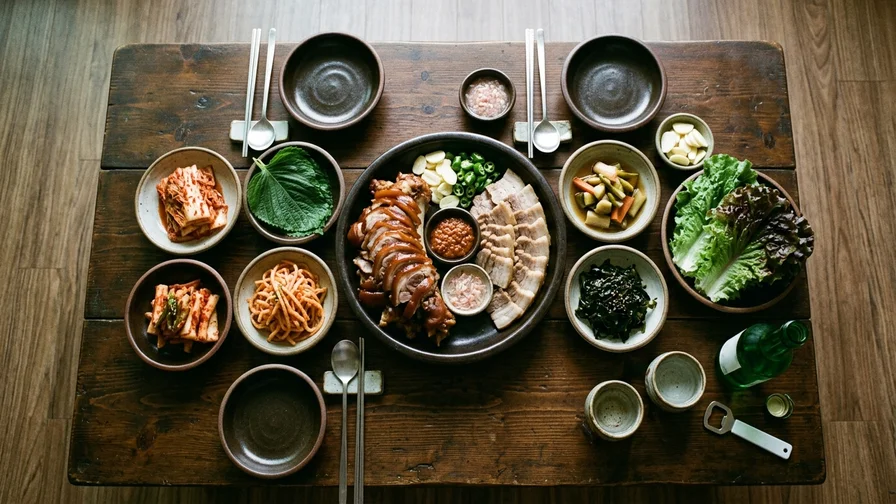
When you order jokbal and bossam, the following side dishes and sauces typically come with them.
- Saeujeot: Tiny shrimp fermented in salt. An essential sauce whose saltiness and savory depth cut through the richness of the meat. Avoid it if you have a shellfish allergy
- Ssamjang: A sauce made by mixing doenjang and gochujang. Mainly used when making wraps
- Lettuce and Perilla Leaves: Fresh leafy greens for wrapping the meat and other ingredients
- Raw Garlic and Green Chili Peppers: Added to wraps for a sharp, pungent kick
- Bossam Kimchi: Kimchi made separately just for bossam. Sweeter and crunchier than regular kimchi
The Home of Jokbal: Jangchung-dong Jokbal Street
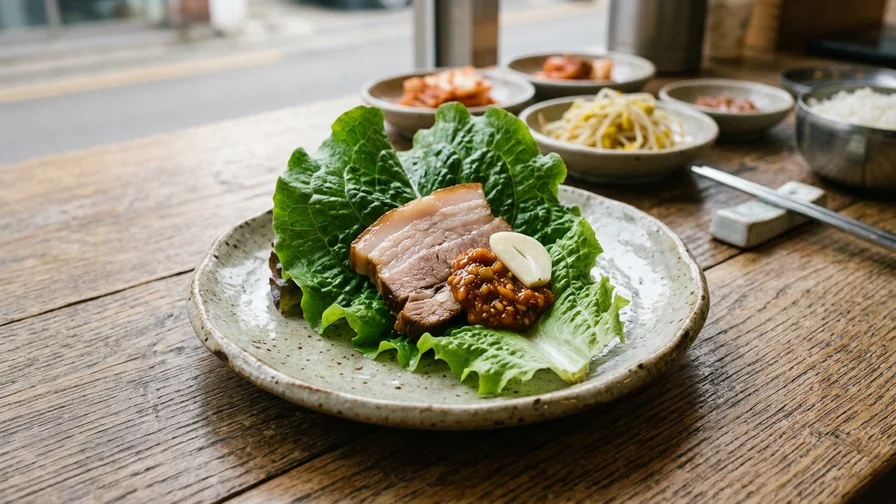
Jangchung-dong jokbal carries within it a small piece of the history of Korea’s division. During the Korean War, displaced people from the Pyeongan-do and Hwanghae-do provinces of the north came south and settled in this neighborhood, where they began selling a simplified version of the braised pig’s trotters they used to eat back home on big occasions like weddings and holidays. That dish became today’s jokbal. The jokbal shops opened around the mid-to-late 1960s, and as crowds spilled out of the Jangchung Gymnasium just across the street (which opened in 1963) after watching matches, the alley filled up and flourished into a “jokbal mecca” through the 1970s. Even now, several decades-old shops serve the same tender, mild style of jokbal.
Location and How to Get There
Jangchung-dong Jokbal Street is in Jangchung-dong, Jung-gu, Seoul. Public transit is the easiest way to get there.
- Subway: Take Exit 3 of Dongguk University Station (Line 3) and walk straight for about 100 meters, and you’ll see the street where the jokbal restaurants are clustered. It’s a 1–2 minute walk to Pyeongando Jokbaljip
- Map: Jangchung-dong Jokbal Street
Key Restaurants
Jangchung-dong has several jokbal shops with similar names and storefronts, and most maintain a high standard. The old shops center on jokbal as a single signature dish, served alongside mak-guksu (spicy buckwheat noodles) or bindaetteok (mung bean pancake). If you have to pick one combination to try, it’s alternating bites of warm jokbal with tangy mak-guksu, a formula this neighborhood has kept for 60 years.
| Restaurant Name | Features | Prices and Hours (as of June 2026) |
|---|---|---|
| Pyeongando Jokbaljip 📍 | The grand old institution of Jangchung-dong Jokbal Street. Famous for tender jokbal with no gaminess, it’s always packed. No reservations; first-come, on-site waitlist only | Jokbal small 30,000 won / medium 40,000 won / large 50,000 won Mak-guksu 8,000 won 11:00–21:00 (last order 20:10), closed Mondays |
| Ddungddungi Halmeoni-jip 📍 | One of the original shops, running since the late 1950s–1960s. Known for the balance of chewy skin and mild lean meat. It has a single-portion “eat-alone” set, which is especially handy for solo travelers | Jokbal small 30,000 won / medium 40,000 won / large 50,000 won Eat-alone set 19,000 won 10:00–23:00, closed Tuesdays |
| Wonjo 1-ho Jangchungdong Halmeoni-jip 📍 | Another long-standing shop, known for jokbal sliced fresh to order. It offers a varied range of accompaniments like mung bean pancake and platter-style mak-guksu | Jokbal small 30,000 won / medium 40,000 won / large 50,000 won Mung bean pancake 10,000 won 10:30–22:30, closed Wednesdays |
* Prices and hours are as of June 2026 and may change. All three shops close on different days of the week, so check before you go.
The Heart of Seoul: Jokbal and Bossam in Jongno
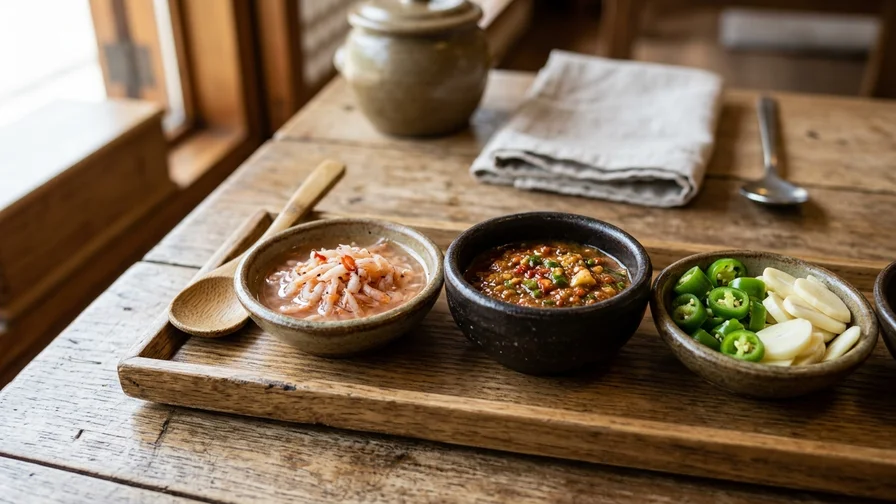
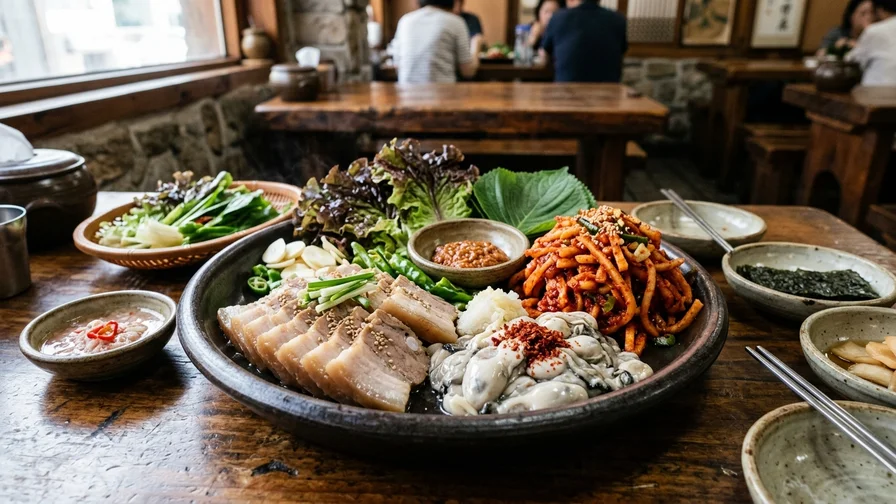
In the back alleys between Jongno 2-ga and Jongno 3-ga (the former site of Pimatgol) is a bossam alley lined with bossam restaurants. The alley took shape in the 1980s, and especially once the cold winds start to blow, it fills up with people coming for gul bossam (bossam with fresh oysters), which pairs fresh oysters with the boiled pork.
Location and How to Get There
- Bossam alley: A 2–3 minute walk from Exit 15 of Jongno 3-ga Station (Lines 1, 3, 5). Map: Jongno 3-ga bossam alley (Supyo-ro 20-gil)
- Jinhyang Jokbal: In a separate location from the bossam alley, near Exit 4 of Jongno 5-ga Station (Line 1), right beside Gwangjang Market on the main road. About a 10-minute walk from the bossam alley
Key Restaurants
In Jongno you can try traditional jokbal and bossam, of course, as well as distinctive dishes like gul bossam. If you pick just one thing in this neighborhood, go for the special combo platter at Janggun Gul Bossam, which puts oysters, sea squirt, jokbal, and bossam all on one table. It’s the most efficient way to taste and compare both dishes at once.
| Restaurant Name | Features | Prices and Hours (as of June 2026) |
|---|---|---|
| Janggun Gul Bossam (Jongno 3-ga Main Branch) 📍 | An old shop specializing in gul bossam for over 30 years. It uses oysters shipped directly from Tongyeong, and when you order bossam, gamjatang (pork back-bone stew) and ojingeo-bokkeum (stir-fried squid) come as standard | Gul bossam small 29,000 won / medium 38,000 won / large 45,000 won Special combo (oysters + sea squirt + jokbal + bossam) 55,000 won Daily 11:30–23:00 |
| Choi Buja Bossam 📍 | Another popular spot in the bossam alley. Known for generous portions, fresh oysters, and bossam kimchi; order bossam and dongtae-jeon (pollack pancake) and gamjatang come complimentary | Gul bossam 29,000–44,000 won King jokbal 35,000–44,000 won Daily 11:00–23:00, open every day |
| Jinhyang Jokbal 📍 | A jokbal specialist beside Gwangjang Market in Jongno 5-ga. They boil domestic fresh trotters daily and sell only a limited quantity, so they may sell out late at night. A place focused on the pure taste of warm, tender jokbal | Front leg 45,000 won / hind leg 41,000 won / jokbal small 37,000 won Jinhyang cold jokbal salad (naengchae jokbal) 45,000 won Daily 11:00–23:00 |
* The oysters in gul bossam are seasonal, with fresh raw oysters available roughly from October to March. Outside that window, it’s best to check in advance whether they’re offered.
How to Order and Eat
Ordering
Jokbal and bossam are usually ordered by size. Portions vary by restaurant, but here’s a rough guide.
- So: Small, typically for 1–2 people
- Jung: Medium, typically for 2–3 people
- Dae: Large, typically for 3–4 people
If you want to try both, check whether there’s a “Modeum” (combination) or “Banban” (half-half) option that serves jokbal and bossam together. It’s common at bossam shops, but the old Jangchung-dong shops focus on jokbal as a single dish, so they often don’t have it. For a meal item, adding mak-guksu or jaengban-guksu (platter noodles) goes well as something to alternate with the meat. Skip the mak-guksu if you have a buckwheat allergy.
Point-and-Order Phrases
- Jokbal jung-jja hana juseyo — One medium-sized jokbal, please
- Banban dwaeyo? — Can I get it half jokbal, half bossam?
- Saeujeot jom deo juseyo — A refill of saeujeot, please
- Pojang dwaeyo? — Is takeout available?
Solo Travelers
A two-portion minimum order is common at Korean meat restaurants, but jokbal and bossam are, surprisingly, open to solo travelers too.
- Jangchung-dong’s Ddungddungi Halmeoni-jip has an eat-alone set (19,000 won, as of June 2026), so you can experience old-shop jokbal as a single portion
- The small (so) size is also meant for 1–2 people, so if you have a big appetite, a small plus a takeout box for one is also doable
- Delivery apps and franchise jokbal shops have made single-portion set menus commonplace
The Tasty Way to Eat: The Ssam Method
The best way to enjoy jokbal and bossam is to eat them in a “ssam” (wrap). Ssam comes from the Korean verb meaning “to wrap.”
- Place 1–2 leaves of lettuce, perilla, or salted cabbage on your palm
- Set a piece of jokbal or bossam on top
- Add a little bossam kimchi or musaengchae
- To taste, add a slice of raw garlic dipped in ssamjang or saeujeot
- Wrap it up well so nothing spills out and pop it in your mouth in one bite. All the flavors of the different ingredients come together at once
Drink Pairings
Jokbal and bossam pair well with Korea’s popular drinks.
- Soju: The most popular pairing, its clean, slightly bitter taste cuts through the richness of the pork. About 5,000–6,000 won a bottle at restaurants
- Makgeolli: A fermented rice wine whose subtle sweetness and refreshing fizz go well with the salty, spicy bossam kimchi. An especially good match when bindaetteok is on the table
Late-Night Delivery Culture
Along with fried chicken, jokbal is one of the two pillars of Korean late-night delivery. One distinction is worth making, though: the old Jangchung-dong and Jongno shops featured here are sit-down places that operate from daytime until 9–11 p.m., while the spots selling jokbal into the early morning hours are delivery-only shops. Delivery apps (like Baemin) require a Korean phone number and a Korean payment method, which can be a barrier for short-term travelers, so while traveling, a more practical approach is to eat at the old shops and take the leftovers back to enjoy at your accommodation. Most jokbal shops take takeout orders.
Practical Information for Travelers
Dietary Notes
- These are pork dishes: Both dishes are pork-based, so they’re not suitable for halal or kosher diets. Vegetarian alternatives are essentially nonexistent at these restaurants
- Hidden seafood: The default saeujeot sauce is crustacean (shrimp), and the oysters in gul bossam are shellfish. If you have a crustacean or shellfish allergy, ask “Saeujeot ppae juseyo” (please leave out the saeujeot) and use ssamjang instead
- Other: The jokbal broth contains medicinal herbs and soy sauce (which may contain soy and wheat), and mak-guksu is made with buckwheat noodles
Budgeting
Here’s a breakdown to reference when planning a budget for a group of four (as of June 2026).
- Main dish (large jokbal or bossam): about 45,000–50,000 won
- Side dishes (mak-guksu, bindaetteok, etc.): about 8,000–18,000 won
- Drinks: 5,000–10,000 won per person
For four people, expect a total budget of around 80,000 to 100,000 won. For two, a medium size plus a mak-guksu comes to about 50,000 won.
Business Hours and Reservations
The Jangchung-dong old shops aren’t late-night joints; they open around 10–11 a.m. and close at 9–11 p.m. (Pyeongando Jokbaljip closes at 21:00, with last orders by 20:10). The Jongno bossam alley restaurants generally stay open until 11 p.m. On Friday and Saturday evenings, the waits can get long, and some places like Pyeongando Jokbaljip take no reservations, only an on-site waitlist. Smaller restaurants that take phone reservations may require speaking Korean. The three Jangchung-dong old shops close on Monday, Tuesday, and Wednesday respectively, all different, so check the table above before you go.
Transportation
Seoul’s subway is the most efficient option: for Jangchung-dong use Exit 3 of Dongguk University Station (Line 3), for the Jongno bossam alley use Exit 15 of Jongno 3-ga Station (Lines 1, 3, 5), and for Jinhyang Jokbal use Exit 4 of Jongno 5-ga Station (Line 1). If you take a taxi, the Kakao T app is handy, but signing up can be restricted without a Korean phone number or a Korean-issued card. In that case, hailing a regular taxi on the street or asking your hotel to call one is the alternative.
Language and Communication
Editor’s Tip
Most well-known restaurants have menus with photos or with English, Japanese, and Chinese alongside the Korean. You can order easily by pointing to the dish you want and saying “Igeo juseyo” (please give me this one). If you run into trouble communicating, use the tourist interpretation hotline 1330. Run by the Korea Tourism Organization, it provides 24-hour interpretation and travel information in various languages including English, Japanese, and Chinese.