The Diplomat’s Day You Never See On Screen in K-Dramas
목차
In K-dramas and Korean films, diplomats are often portrayed gliding across the international stage with fluent foreign languages and cool-headed negotiating skills. But here’s a surprising fact — Korean dramas with a diplomat as the lead are rare enough to count on one hand. Instead, it’s the films based on true stories that have shown the real face of this profession. In this article, under the keyword diplomats in K-dramas, we round up verified works that actually exist, the real path to becoming a diplomat, and the historic sites of diplomacy in Seoul that you can walk through yourself. For the full picture of professions in K-dramas, check out Exploring Jobs in K-Dramas.
Key Takeaways
- Diplomat-led dramas are rare: There are almost no K-dramas with a diplomat as the pure protagonist. Period pieces (Mr. Sunshine) and political dramas (Designated Survivor: 60 Days) give diplomacy substantial weight, while three films based on true stories (Escape from Mogadishu, The Point Men, The Negotiation/Ransomed) tackle the profession head-on.
- Real life is more dramatic than fiction: Actual events like the joint escape of North and South Korean embassy staff during the 1991 Somali Civil War and the 1986 abduction of a Korean diplomat in Lebanon are the source material for these films.
- You can visit the sites in person: The Jeong-dong area of Seoul (Jungmyeongjeon Hall, Dondeokjeon Hall, the old Russian Legation) was the real stage of late-Joseon diplomatic history, and you can walk to all of them from City Hall Station.
The Works That Actually Exist: K-Content Featuring Diplomats
Search for “diplomat drama” and the American Netflix series The Diplomat comes up first — that’s how rare the diplomat is as a lead in Korean dramas. Instead, the works below are a curated list of titles whose actual broadcast or theatrical release has been confirmed.
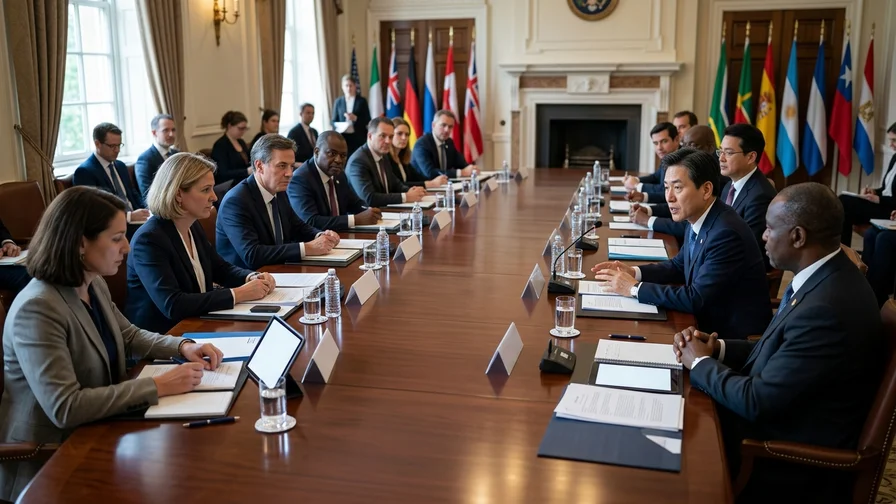
Dramas: Diplomacy Through Period and Political Pieces
- Mr. Sunshine (tvN, 2018): Set in the Korean Empire from 1900 to 1907. The protagonist Eugene Choi (Lee Byung-hun) arrives in Seoul’s Jeong-dong as a U.S. Army officer serving as acting consul at the American Legation. The diplomatic quarter of Jeong-dong, crowded with the legations of foreign powers, and the desperate diplomatic struggle of a Joseon on the brink form the drama’s central axis. It’s the best work for understanding the diplomatic context of the late Joseon era on screen.
- Designated Survivor: 60 Days (tvN, 2019): A political drama in which a bomb attack on the National Assembly kills the president and the cabinet, and Park Mu-jin (Ji Jin-hee), the Minister of Environment, becomes acting president. A remake of the American ABC series Designated Survivor, it features the pressure of the Korea-U.S. alliance and diplomatic-security negotiations amid an inter-Korean crisis as central conflicts.
- Vincenzo (tvN, 2021): Not a diplomat story (the lead is a Korean-Italian lawyer tied to the Italian mafia). Still, as the popularity of its setting — moving between the international stage and Korea — shows, the “global professional” is a winning formula in K-dramas, yet a drama centered on the actual job of a diplomat remains close to a blank space.
Films: Three True Stories That Reveal the Real Face of Diplomats
- Escape from Mogadishu (2021, dir. Ryoo Seung-wan): Based on the true story of how stranded North and South Korean embassy staff escaped Mogadishu together during the 1991 Somali Civil War. It draws on the actual experience of Ambassador Kang Shin-sung of the time and was the top-grossing Korean film of 2021. The image of diplomats protecting their citizens and embassy staff amid gunfire is portrayed more desperately than any action film.
- The Point Men (2023, dir. Yim Soon-rye): The story of diplomat Jae-ho (Hwang Jung-min) and a National Intelligence Service agent (Hyun Bin) rescuing Koreans abducted in Afghanistan. It’s based on the actual 2007 abduction of Koreans. Rather than “diplomacy at the negotiating table,” it deals with life-or-death on-the-ground negotiation.
- Ransomed (2023, dir. Kim Sung-hoon): Based on the true story of Korean diplomat Secretary Do Jae-seung, who was kidnapped by armed assailants in Beirut, Lebanon, in 1986 and returned alive after 21 months. It’s dramatized into the story of diplomat Min-jun (Ha Jung-woo), who sets out to rescue his colleague, and a local taxi driver (Ju Ji-hoon).
Reality Behind the Glamour: A Diplomat’s Work and Hardships
What these works share is showing not lavish banquets but the weight of the profession. Here are only the verifiable facts about the daily life of an actual diplomat.
Communication That Crosses Language and Cultural Barriers
- A foreign language is more than a communication tool — it’s a weapon for building trust. Diplomats must master not only the language and history of their host country but also its customs and cultural taboos.
- As Escape from Mogadishu and Ransomed show, in a crisis a single word of the local language and a local network can mean the difference between life and death.
Rotational Postings and Family Sacrifice
- Korean diplomats rotate between headquarters and overseas missions, and overseas postings typically change every 2–3 years.
- Children have to keep changing schools, and spouses often find it difficult to continue their careers in unfamiliar environments.
- That postings to hardship locations (conflict zones, areas with poor medical infrastructure) are part of the rotation is another reality of this profession — Somalia, the backdrop of Mogadishu, was exactly that kind of post.
Editor’s Tip
The availability of the three films above on OTT platforms changes from time to time, so if you want to watch them, the most accurate approach is to use a search service like JustWatch or to search the title directly on each platform. And if you’ve seen Mr. Sunshine, walk through Seoul’s Jeong-dong, the drama’s actual setting — the places in the section below are all clustered within a 20-minute walk.
Diplomatic Sites You Can Visit: Seoul’s Jeong-dong
Jeong-dong, where the legations of foreign powers were clustered in the late Joseon era, is the actual stage of Korean diplomatic history. Get off at City Hall Station and walk along the Deoksugung stone-wall path, and you can tour the sites below in one course. Operating information is as of June 2026.
- Jungmyeongjeon Hall, Deoksugung: The very building where the 1905 Eulsa Treaty (the treaty stripping the Korean Empire of its diplomatic sovereignty) was signed. Tue–Sun 09:30–17:30, closed Mondays, free. It sits in an alley next to the Jeongdong Theater, so it’s easy to walk past — watch out. Don’t miss: the reenactment of the Eulsa Treaty signing in the first-floor exhibition hall — you can stand right there and see in which room a nation lost its diplomatic sovereignty.
- Dondeokjeon Hall, Deoksugung: A Western-style guest hall where Emperor Gojong received diplomatic envoys. Demolished during the Japanese colonial period, it was reconstructed after 100 years and opened in September 2023. The interior is an exhibition space on the diplomatic history of the Korean Empire. Deoksugung admission is 1,000 won for adults (free for under 25 and over 65), closed Mondays. For official information, see the Royal Palaces and Tombs Center.
- Old Russian Legation, Jeongdong Park: The site of the Korea royal refuge (Agwan Pacheon) where Emperor Gojong took shelter for a year in 1896. Today only the white tower portion remains. As a park, it’s open at all times and free.
- Ministry of Foreign Affairs Building: The Republic of Korea’s Ministry of Foreign Affairs is currently located in the annex of the Government Complex Seoul in Gwanghwamun (60 Sajik-ro 8-gil, Jongno-gu). Public interior tours are not regularly available, so you can only see the exterior. It’s right next to Gyeongbokgung and Gwanghwamun Square, so you’ll pass by it during a Gwanghwamun visit without needing to go out of your way.
Getting there: Take Subway Line 1 or 2 to City Hall Station → Daehanmun, the main gate of Deoksugung, is right in front of Exit 2 of Line 1. From Daehanmun, follow the stone-wall path into Jeongdong-gil and you’ll reach Jungmyeongjeon Hall and Jeongdong Park in turn. The whole course is easily walkable, and even at a leisurely pace it takes about half a day.
The Path to Becoming a Diplomat: The Exam and the Korea National Diplomatic Academy
Here’s an accurate rundown of the actual process — and the current state of the system — for becoming a diplomat like those in these works.
The Abolition of the Foreign Service Exam and the Diplomat Candidate Selection Test
- The former “Foreign Service Exam” was abolished after its 47th edition in 2013.
- The current system is the Diplomat Candidate Selection Test — recruiting in the divisions of general diplomacy, regional diplomacy, and specialized diplomacy.
- The crucial difference from the old Foreign Service Exam: passing does not make you a diplomat right away. Successful candidates must complete about a year of regular coursework at the Korea National Diplomatic Academy (launched in 2012, located in Seocho-gu, Seoul) and pass a grade evaluation to be formally appointed.
- Exam schedules and detailed guidelines can be checked on the official Ministry of Foreign Affairs website and the official Korea National Diplomatic Academy website (as of June 2026).
How K-Content Shaped the Public Image of the Diplomatic Profession
- The success of Escape from Mogadishu and Ransomed imprinted on the public the image of “the diplomat who protects citizens out of sight.”
- Because both films portrayed not glamorous negotiators but public servants holding the line at crisis sites, they’re credited with creating a perception closer to the actual profession than the vague elite image of the past.
In sum, diplomats in K-dramas remain close to an unfilled genre, and films based on true stories have filled that void with overwhelming density. Watch the diplomatic struggle of late-Joseon Jeong-dong in Mr. Sunshine, see the front lines of modern diplomats in Escape from Mogadishu and Ransomed, and then walk Seoul’s Jeongdong-gil yourself — you’ll experience screen and history connecting in a single line. If you’re curious about the wide range of jobs in K-dramas, continue with the story of jobs in K-dramas; for another profession that demands high expertise and sacrifice, read on at the world of medical professionals in K-dramas.