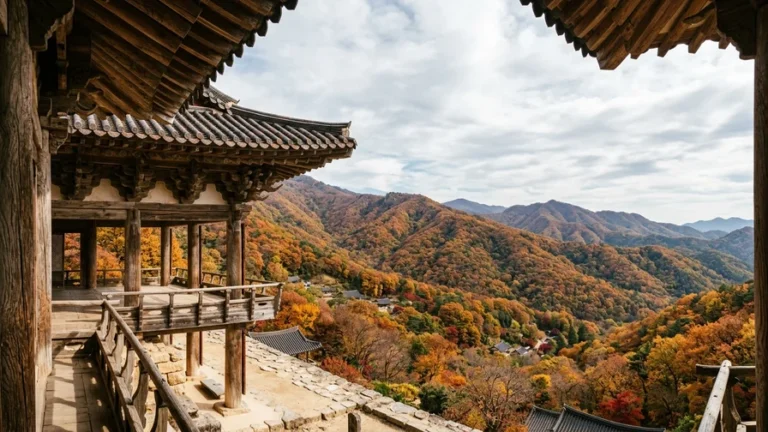
Baekje Historic Areas (UNESCO 2015)
Contents
- Why the 2015 Inscription Matters: Traces of Ancient Korea–China–Japan Exchange
- Gongju: The Ungjin Baekje Period (475–538)
- Buyeo: The Sabi Baekje Period (538–660)
- Iksan: Mireuksa Temple Site and Wanggung-ri Palace Site
- Recommended 2-Day Itinerary (Departing from Seoul)
- Local Food in the Area
- Practical Tips for International Travelers
- Frequently Asked Questions (FAQ)
The Baekje Historic Areas is a group of eight archaeological sites from the later period (475–660 CE) of the ancient kingdom of Baekje, inscribed on the UNESCO World Heritage List in 2015 (UNESCO official inscription page). The sites are scattered across Gongju in Chungcheongnam-do, Buyeo, and Iksan in Jeonbuk State, illustrating 185 years of shifting capitals and the development of Baekje culture. Following the route that connects all three cities lets you read the final glory of Baekje right up to the eve of its fall.
- Three cities, one kingdom: Eight sites across Gongju, Buyeo, and Iksan reveal how the late Baekje capital moved and what role each city played
- A variety of site types: Palace grounds, defensive fortresses, royal tombs, and temple sites that showcase Baekje life, faith, and architectural skill
- Evidence of East Asian exchange: The sites and their excavated artifacts prove active exchange with China and Japan as well as the formation of a distinctive culture
- Information note: All admission fees, opening hours, and transit details in this article were verified against official sources as of June 2026
Why the 2015 Inscription Matters: Traces of Ancient Korea–China–Japan Exchange
The value of these Baekje Historic Areas goes well beyond simple preservation. They are key evidence of East Asian cultural exchange—Baekje absorbed architectural techniques, Buddhism, and artistic styles from China’s Southern Dynasties, made them its own, and passed them on to Japan.
- Adoption from China: Artifacts excavated from the Tomb of King Muryeong prove direct trade relations with China
- Transmission to Japan: The sculptural beauty of the Five-story Stone Pagoda at the Jeongnimsa Temple Site influenced wooden pagoda architecture in Japan
- A crossroads of civilizations: The sites prove Baekje served as a crossroads of ancient East Asian civilization
Gongju: The Ungjin Baekje Period (475–538)
This was the period when, pushed back by Goguryeo’s southern advance, Baekje moved its capital from Hanseong (present-day Seoul) to Ungjin (present-day Gongju). In Gongju, with its defensively advantageous terrain, Baekje rebuilt the state and developed its culture. You can re-check admission fees and hours for the two key sites at the official Gongju culture and tourism guide.
Gongsanseong Fortress
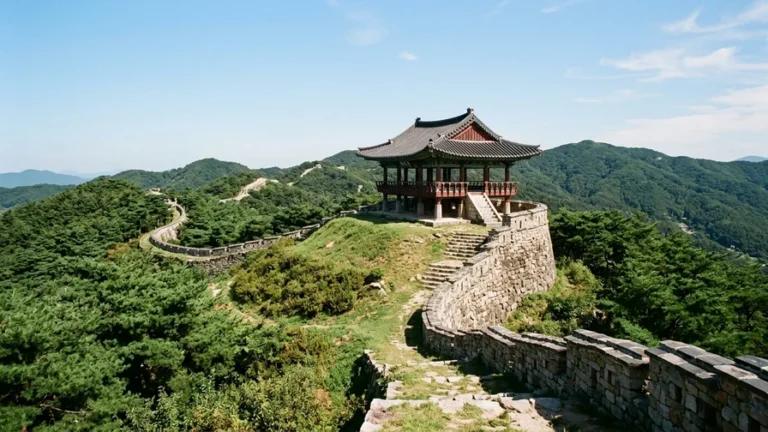
A royal fortress on a hill embraced by the Geumgang River. It began as an early earthen rampart and was later rebuilt as a stone fortress during the Joseon dynasty.
- Fortress scale: About 2.6 km in circumference; the full walk takes roughly 1 to 1.5 hours
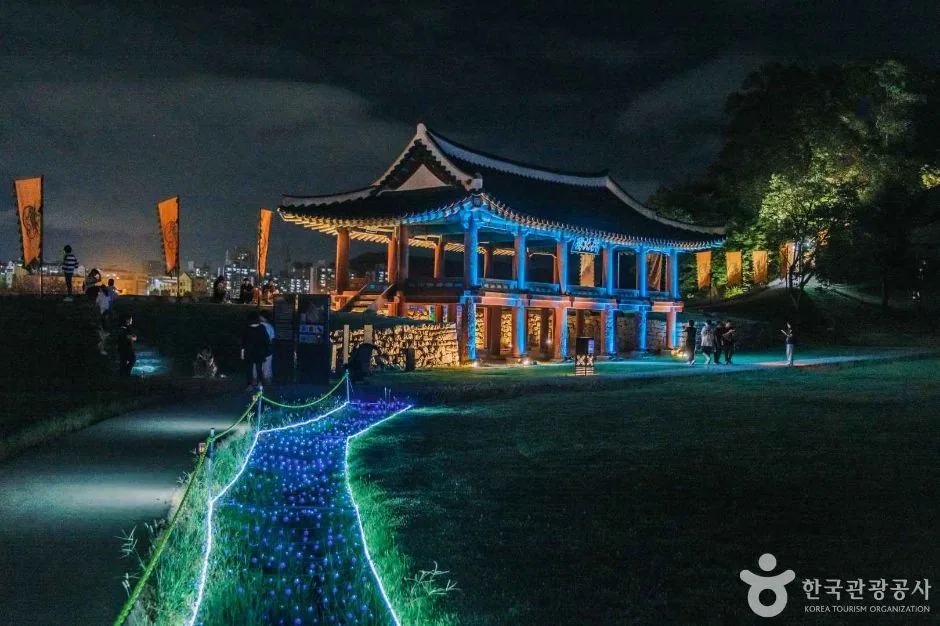
- Don’t miss: The Geumseoru Gate stretch at the west gate, just above the ticket booth—beyond the flag-lined fortress path, downtown Gongju and the Geumgang River open up at a glance, the signature view of Gongsanseong
- Excavations: Building foundations believed to be a Baekje palace site, along with the remains of a pond, have been confirmed
- Address: 280 Ungjin-ro, Gongju-si, Chungcheongnam-do (Google Maps)
- Opening hours: Mar–Oct 09:00–18:00, Nov–Feb 09:00–17:00 (last entry 30 minutes before closing); closed Jan 1 and on Seollal and Chuseok
- Admission: Adults 3,000 won (about $2.2), youth 2,000 won (about $1.4), children 1,000 won (about $0.7) — as of June 2026
- Combination ticket: A bundle of three sites—Gongsanseong, the Royal Tombs at Songsan-ri, and the Seokjang-ri Museum—costs 6,000 won for adults, 4,000 won for youth, and 2,000 won for children. Buy it at the ticket booth of whichever site you visit first—it pays off even if you only see Gongsanseong and the royal tombs
- Highlight: The illuminated fortress walls make for a great evening view, and there are scheduled night openings during set periods (check the official site before visiting)
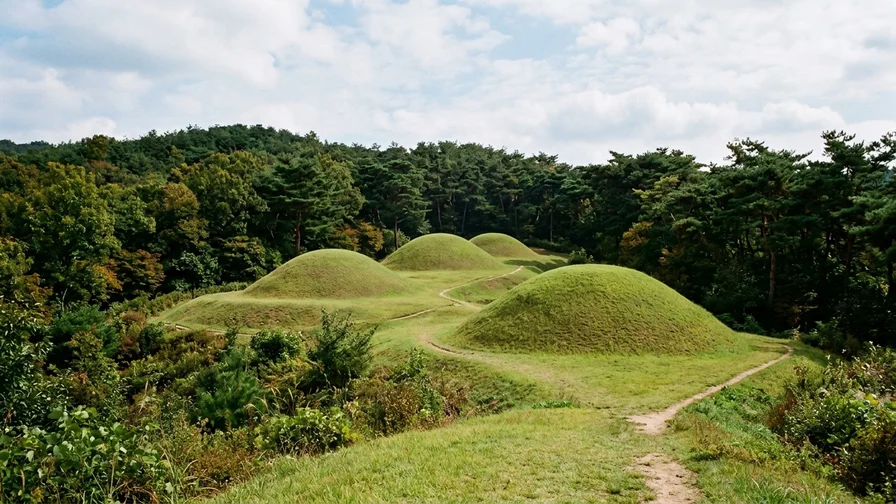
Royal Tombs at Songsan-ri, including the Tomb of King Muryeong
This is where the tombs of kings and royalty from the Ungjin period are gathered. In September 2021 the official name changed from the old “Songsan-ri Tombs” to “Royal Tombs at Songsan-ri, Gongju,” so you may see both names on local signage. The centerpiece is Tomb No. 7, the Tomb of King Muryeong.
- Excavated in 1971: Unearthed completely intact and never looted, it provided groundbreaking material for the study of Baekje history
- Confirmed occupants: Memorial stones (epitaph tablets) identifying the king and queen were found, making it the only Baekje royal tomb whose occupants are known
- Finds: Over 4,600 items, including gold crown ornaments, jewelry, and Chinese Pottery (도자기, dojagi)
- How you view it: The tomb interiors are closed for preservation; at the model exhibition hall you can view re-created interiors and replica artifacts
- Don’t miss: The originals are across the road at the Gongju National Museum (free; closed Mondays, Jan 1, and on Seollal and Chuseok). The jinmyosu stone guardian beast that watched over the tomb entrance and the gold crown ornaments of the king and queen are the highlights of the King Muryeong gallery—be sure to pair this with the tomb visit
- Address: 37 Wangneung-ro, Gongju-si, Chungcheongnam-do (Google Maps)
- Opening hours: Mar–Oct 09:00–18:00, Nov–Feb 09:00–17:00 (last entry 30 minutes before closing); closed Jan 1 and on Seollal and Chuseok
- Admission: Adults 3,000 won (about $2.2), youth 2,000 won (about $1.4), children 1,000 won (about $0.7) — as of June 2026; the combination ticket is valid here
Buyeo: The Sabi Baekje Period (538–660)
This was the period when King Seong moved the capital to Sabi (present-day Buyeo), ushering in the golden age of Baekje culture, marked by a planned city layout and refined Buddhist art. The sites in downtown Buyeo are within walking distance of one another, and between them lies Gungnamji Pond (free, open year-round), Korea’s first artificial pond garden—perfect to slot in as a lotus-stroll detour during the Seodong Lotus Festival season in July.
Gwanbuk-ri Administrative Buildings and Busosanseong Fortress
The site of Baekje’s last royal fortress during the Sabi period. It served as a royal rear garden in peacetime and a defensive fortress in times of crisis.
- Main attractions: Nakhwaam Rock, steeped in the legend of the “three thousand court ladies,” and Samchungsa Shrine, which honors loyal subjects
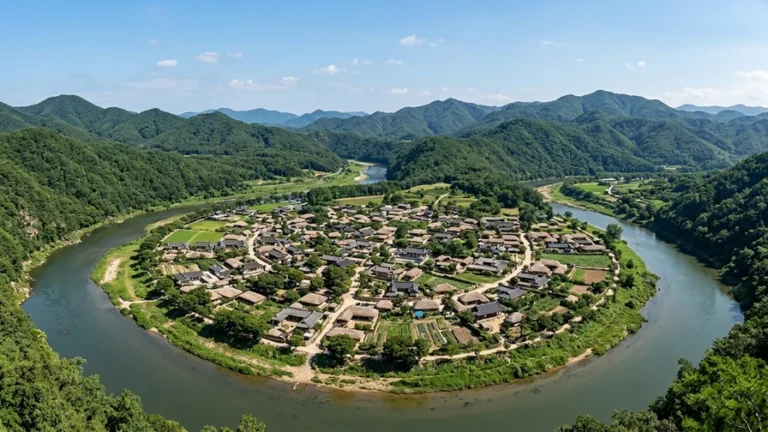
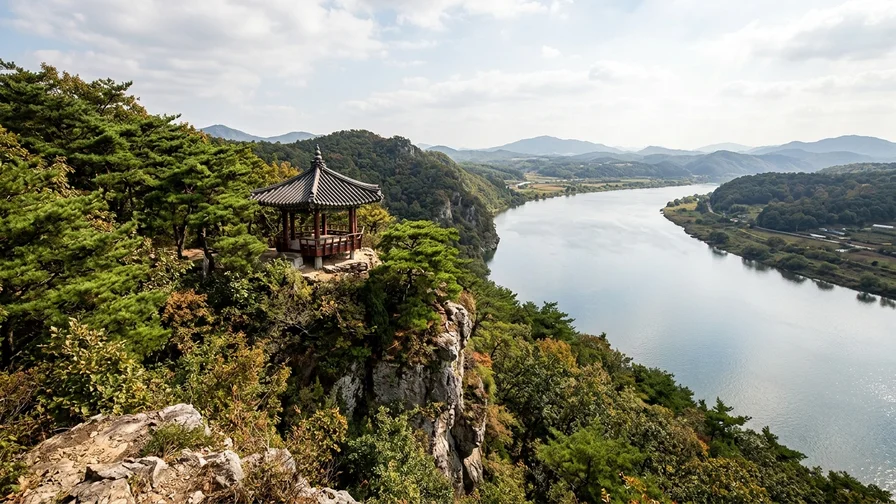
- Don’t miss: Stand at Baekhwajeong Pavilion atop Nakhwaam and the Baengmagang (the Buyeo stretch of the Geumgang River) winds below your feet—the scenery itself explains why the legend of Baekje’s fall became attached to this cliff
- Exploring: Well-maintained walking paths; a light 1.5–2 hour tour is just right
- Address: 31 Buso-ro, Buyeo-eup, Buyeo-gun, Chungcheongnam-do (Google Maps)
- Opening hours: Summer (Mar–Oct) 09:00–18:00, winter (Nov–Feb) 09:00–17:00; closed on Seollal and Chuseok
- Admission: Adults 2,000 won (about $1.4), youth 1,100 won (about $0.8), children 1,000 won (about $0.7) — as of June 2026
Jeongnimsa Temple Site and Five-story Stone Pagoda
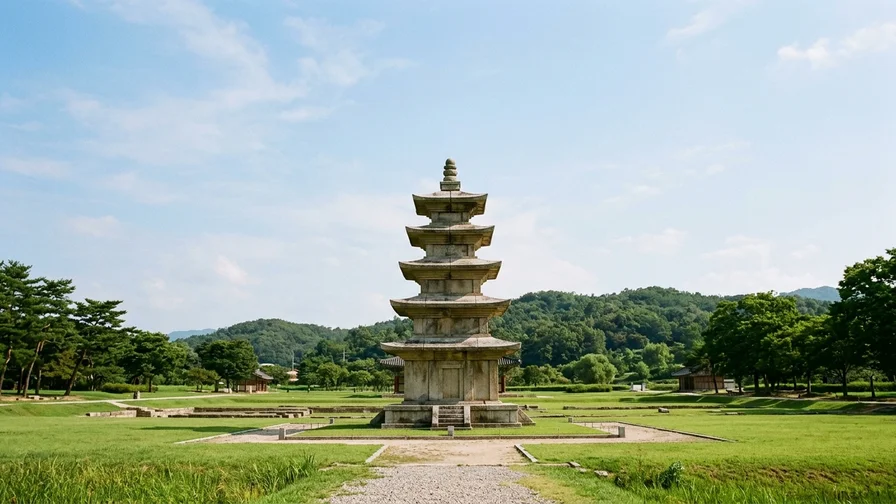
A temple site at the heart of the Sabi capital. The buildings are gone, and only the Five-story Stone Pagoda (a National Treasure) at the Jeongnimsa Temple Site remains.
- Design: Wooden-architecture techniques rendered in stone, with stable proportions and refined sculptural beauty
- Historical record: Inscriptions remain on the pagoda body recording the achievements of the Tang general Su Dingfang in bringing down Baekje
- Facilities: The Jeongnimsa-ji Museum provides information on Sabi-era Buddhist culture
- Address: 83 Jeongnim-ro, Buyeo-eup, Buyeo-gun, Chungcheongnam-do (Google Maps)
- Opening hours: Summer (Mar–Oct) 09:00–18:00, winter (Nov–Feb) 09:00–17:00. The site (excluding the museum) stays open until 22:00 in summer and 21:00 in winter—the illuminated stone pagoda is worth seeing
- Admission: Free (museum included) — as of June 2026
Royal Tombs at Neungsan-ri
A cluster of Sabi-era royal tombs outside the Buyeo Naseong outer wall. In September 2021 the official name changed from the old “Neungsan-ri Tombs” to “Royal Tombs at Neungsan-ri.” They share the same corridor-style stone chamber form as the tombs at the Royal Tombs at Songsan-ri.
- Signature artifact: The Gilt-bronze Incense Burner of Baekje was discovered at a temple site to the west
- Don’t miss: The original Gilt-bronze Incense Burner of Baekje is at the Buyeo National Museum (free; closed Mondays, Jan 1, and on Seollal and Chuseok). Standing 61.8 cm tall, its lid features a phoenix at the summit, beneath which 74 mountain peaks and figures and animals—including five musicians—are rendered in relief, the pinnacle of Baekje craftsmanship. If you can see only one thing in Buyeo, make it this
- Address: 61 Wangneung-ro, Buyeo-eup, Buyeo-gun, Chungcheongnam-do (Google Maps)
- Opening hours: Summer (Mar–Oct) 09:00–18:00, winter (Nov–Feb) 09:00–17:00; closed on Seollal and Chuseok
- Admission: Adults 1,000 won (about $0.7), youth 600 won, children 400 won — as of June 2026
Iksan: Mireuksa Temple Site and Wanggung-ri Palace Site
Iksan is a large-scale city site built during the reign of King Mu of Baekje. Believed to have been a second capital or a separate base city, it preserves the largest temple of the late Baekje period along with a palace site.
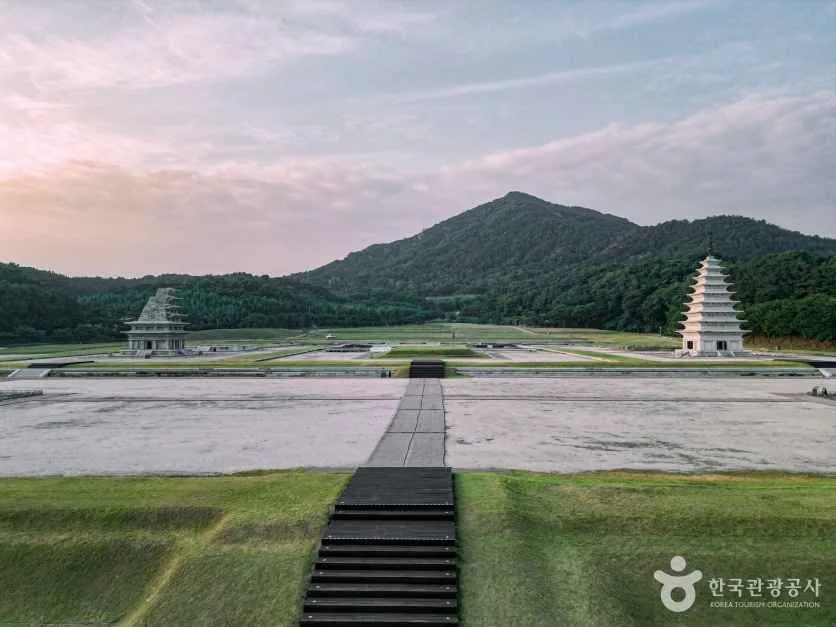
- Mireuksa Temple Site: The largest temple site of Baekje, with a three-pagoda, three-main-hall (three-courtyard) layout
- Mireuksa Stone Pagoda (National Treasure): The largest and oldest stone pagoda in Korea, unveiled in 2019 after 20 years of restoration
- Restoration approach: Restored only up to six stories using surviving original components, maintaining the authenticity of the site
- Don’t miss: Compare the restored stone pagoda on the west side side by side with the east pagoda restored in 1993—the difference between a restoration using original components and one newly built is plain to see. Artifacts are on view at the Iksan National Museum on the grounds
- Wanggung-ri Palace Site: Presumed to be King Mu’s palace site, with confirmed building foundations, a garden, and even latrine remains
- Wanggung-ri Five-story Stone Pagoda (National Treasure): A sarira reliquary set was discovered during dismantling, providing material for the study of Baekje stone pagodas
- Mireuksa Temple Site address: 362 Mireuksaji-ro, Geumma-myeon, Iksan-si, Jeonbuk State (Google Maps)
- Wanggung-ri Palace Site address: 666 Gungseong-ro, Wanggung-myeon, Iksan-si, Jeonbuk State (Google Maps)
- Opening hours: Sites 09:00–18:00. The Iksan National Museum (free) is closed every Monday, Jan 1, and on Seollal and Chuseok; the Baekje Royal Palace Museum at Wanggung-ri (formerly the Wanggung-ri Site Exhibition Hall, free) is also closed Mondays and Jan 1—if you visit on a Monday you can only see the outdoor sites
- Admission: Both sites are free — as of June 2026
Recommended 2-Day Itinerary (Departing from Seoul)
Here is a 2-day route that efficiently bundles the sites in all three cities. It assumes a public-transport traveler using KTX and intercity buses, with transit details verified October 2026. If you’re only visiting one city, the approach differs—Iksan is best by KTX; Gongju by express bus from Seoul Express Bus Terminal (27 departures daily, about 1 hr 50 min, from 14,900 won for premium class); and Buyeo by intercity bus from Seoul Nambu Terminal (18 departures daily). Gongju’s KTX station, Gongju Station, is 40–50 minutes from downtown by bus, so the bus is faster when heading from Seoul to Gongju only.
| Time | Plan | Transport & Details |
|---|---|---|
| Day 1 Morning | Seoul → Iksan, visit the Mireuksa Temple Site | Take the KTX from Yongsan Station and get off at Iksan Station (about 1 hr 5 min–1 hr 20 min, 29,300 won for standard class, verified October 2026). From the Iksan Station stop, take city bus 41 or 41-1 and get off at Mireuksa Temple Site (about 40 min; bus 60 also passes by, but 60-2 does not). A taxi takes about 30 minutes and roughly 15,000 won. Allow 2–3 hours including the Iksan National Museum. |
| Day 1 Afternoon | Iksan → Gongju, visit the Tomb of King Muryeong and Gongsanseong | Return to Iksan Station from Mireuksa by bus or taxi. From Iksan Station to Gongju Station, the KTX takes 18 minutes (7,500 won, about 30 departures daily, verified October 2026). Gongju Station is far from downtown, so take a 200-series bus such as No. 200 for the 40–50 minute ride into town; if you’re with companions, a taxi is recommended. After visiting the Royal Tombs at Songsan-ri, it’s about a 25-minute walk or a 5-minute taxi ride to Gongsanseong. |
| Day 1 Evening | Gongju → Buyeo, overnight stay | From Gongju Bus Terminal, take the intercity bus to Buyeo (13 departures daily, first bus 07:20, last bus 18:50, 5,900 won for standard, about 40 min) (verified October 2026). The last bus is early, so it’s best to have dinner after arriving in Buyeo. Check in at your accommodation in downtown Buyeo. |
| Day 2 Morning | Visit Buyeo’s downtown sites (Jeongnimsa Temple Site, Busosanseong) | Downtown Buyeo is relatively small and easy to get around on foot. After visiting the Jeongnimsa Temple Site (free), head to Busosanseong. Choose the full course or the highlights course and explore for 1.5–2 hours. |
| Day 2 Afternoon | Visit the Buyeo National Museum, return to Seoul | At the Buyeo National Museum near the Jeongnimsa Temple Site, view key artifacts such as the Gilt-bronze Incense Burner of Baekje (note: closed Mondays). From Buyeo Intercity Bus Terminal, take the intercity bus to Seoul Nambu Terminal (18 departures daily, first bus 06:40, last bus 20:30, about 2 hr 25 min, 20,400 won for premium class) (verified October 2026). |
If time is tight, cut a city; museums close on Mondays: This route covers all the major sites but can feel a bit rushed. For a more relaxed trip, consider dropping either Iksan or Gongju and focusing on just the two cities of Gongju and Buyeo. To really feel the heart of Baekje culture, we recommend allotting more time to Buyeo. Note that all three museums (Gongju, Buyeo, Iksan) are closed on Mondays, so if a Monday falls within your trip you’ll need to rearrange your plans around the outdoor sites.
Local Food in the Area
Sampling the local cuisine alongside your site visits is part of the journey. Here’s a rundown of recommended regional dishes and verified, real restaurants.
Gongju
- Local specialties: Gongju is chestnut country and a city of kalguksu (knife-cut noodle soup) and gukbap—along with chestnut makgeolli and chestnut bread, you’ll find home-style kalguksu spots all over downtown
- Dish of origin: Injeolmi (glutinous rice cake coated in roasted soybean powder) is also said by some to have originated in Gongju
- Saeihak Garden 📍: Serves Gongju gukbap, a marketplace-style beef and radish soup, described as a red broth with kimchi and green onion; it’s right across from Gongsanseong on the bank of the Geumgang River, conveniently on your route (closed Mondays)
- Chogajip 📍: A more than 30-year-old institution that locals name first when they think of kalguksu in Gongju. The standard combo is hand-cut noodle soup (hand-rolled noodles in anchovy broth) with suyuk (boiled sliced pork); it’s in the food alley of Sanseong Market (closed Wednesdays)
- Pitang Kimtang 📍: The flagship spot for kimpitang (a fusion dish of sweet-and-sour pork topped with kimchi and cheese), a Gongju original. Certified as a top Gongju restaurant, with frequent lunchtime queues
Buyeo
- Local specialties: Buyeo is lotus country—thanks to the lotus fields of Gungnamji Pond, there are many restaurants specializing in yeonnipbap (glutinous rice with chestnuts, jujubes, and ginkgo nuts wrapped in a lotus leaf and steamed)
- Jangwon Makguksu 📍: Near Gudeurae Ferry Landing, a line-out-the-door spot with just two menu items—buckwheat noodles in chilled tangy broth and pyeonyuk (thinly sliced pork). Wrapping the noodles in the meat is the classic way to eat it
- Solnaeeum 📍: A Korean restaurant specializing in tteokgalbi (Korean-style patties of minced short-rib meat, shaped and grilled) and yeonnipbap, with a tidy spread of side dishes—a great introduction to Buyeo’s local home cooking
- Yeonnipdam 📍: A hanjeongsik (Korean set-meal) restaurant centered on yeonnipbap, featured on the Korean TV show Baekban Gihaeng (a home-cooked-meal travel program). The aroma that wafts up when you unwrap the lotus leaf is its signature
Iksan
- Dining tip: There are few restaurants right in front of the Mireuksa Temple Site. Realistically, eat in the downtown area around Iksan Station or in Hwangdeung-myeon, about 15 minutes away by car
- Ilhaeok 📍: A long-established kongnamul-gukbap (clear hangover soup of soybean sprouts and rice served by the toryeom method) shop in downtown Iksan. It’s only open from 5:30 a.m. to 2:30 p.m., making it ideal for breakfast
- Jinmi Sikdang 📍: The originator of Hwangdeung bibimbap (bibimbap of rice warmed with beef-bone broth by the toryeom method, topped with raw beef tartare), run by the third generation since 1931. Counted among Korea’s three great bibimbaps alongside Jeonju and Jinju, it’s a point of pride for Iksan
Practical Tips for International Travelers
- Transportation:
- KTX: The fastest way from Seoul to Iksan, with English booking available via Korail. Note that Gongju Station is 40–50 minutes from downtown by bus, so an express bus is recommended when heading to Gongju only
- Intercity/express buses: Efficient for travel between cities and round trips to Seoul. Both Kobus (express buses) and BusTago (intercity buses) support online booking, and on-the-spot purchase at the terminal is easy too
- City buses: Handy for getting between sites within a city; you can board with a T-money transit card or cash (KRW)
- Taxi: Kakao T accepts overseas-issued cards (Visa, Mastercard, American Express, JCB), but sign-up needs SMS verification and some overseas SIMs don’t receive the code (verified October 2026). If verification fails, hail one on the street or ask your hotel to call, and show the driver the address in Korean
- Closing days: The outdoor sites are open nearly year-round (the Gongju sites are closed Jan 1 and on Seollal and Chuseok), but the Gongju, Buyeo, and Iksan national museums that hold the original artifacts are all closed every Monday—if you plan a Monday visit, rearranging your route is essential
- Driving: You can freely tour all three cities by rental car, but a valid International Driving Permit (IDP) is required
- Information & help: Use the Korea Tourism Organization’s 1330 Travel Helpline, a 24-hour multilingual service in English, Japanese, and Chinese (dial 1330, no area code needed)
Frequently Asked Questions (FAQ)
- Can I see all three cities in a single day?
It’s nearly physically impossible. For a day trip from Seoul, focusing on just one city—Gongju or Buyeo—is realistic. - What’s the best season to visit?
The mild spring (April–May) and autumn (September–October) are ideal. The autumn foliage at Gongsanseong and Busosanseong is especially beautiful. To see lotuses, head to Gungnamji Pond in Buyeo in July. - Is there good English signage at the sites?
All the UNESCO-listed sites have signs in English, Japanese, and Chinese, and many museum exhibits offer multilingual explanations too. - Do I need to book tickets in advance?
Most can be bought on-site with little to no wait. The Iksan sites, the Jeongnimsa Temple Site, and the three national museums are entirely free. - What’s the best way to travel between Gongju, Buyeo, and Iksan?
Gongju–Buyeo is served only by intercity bus (13 departures daily, about 40 min) as the sole direct route. Iksan–Gongju is fastest by the 18-minute KTX. Direct services on the Buyeo–Iksan leg are rare, so going via Gongju or Nonsan is common. - Is there a combined entry ticket for the sites?
In Gongju, a combination ticket for three sites—Gongsanseong, the Royal Tombs at Songsan-ri, and the Seokjang-ri Museum—is sold for 6,000 won for adults (a saving versus buying them separately; purchase at the ticket booth of your first stop). In Buyeo, the Jeongnimsa Temple Site is free, so you only need separate tickets for Busosanseong and the Royal Tombs at Neungsan-ri.
Since fares and timetables are current as of June 2026, it’s a good idea to recheck opening hours and special-event information on each site’s official website, such as Buyeo-gun Culture & Tourism, before you visit.
Some photos © Korea Tourism Organization (KOGL Type 1)
Related reads in this series
- 17 UNESCO World Heritage Sites in Korea
- Haeinsa Janggyeong Panjeon & Tripitaka Koreana (UNESCO 1995)
- Gyeongju UNESCO World Heritage (1995, 2000)
- Jongmyo Shrine (UNESCO 1995)
- Changdeokgung Palace & Secret Garden (UNESCO 1997)
- Andong Hahoe & Gyeongju Yangdong Villages (UNESCO 2010)
- Namhansanseong Fortress (UNESCO 2014)
- Sansa, 7 Buddhist Mountain Temples in Korea (UNESCO 2018)
- Bangudae Petroglyphs (UNESCO 2025)