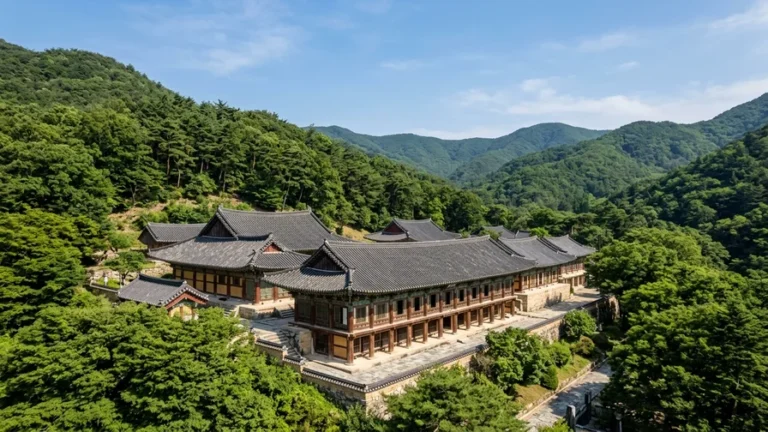
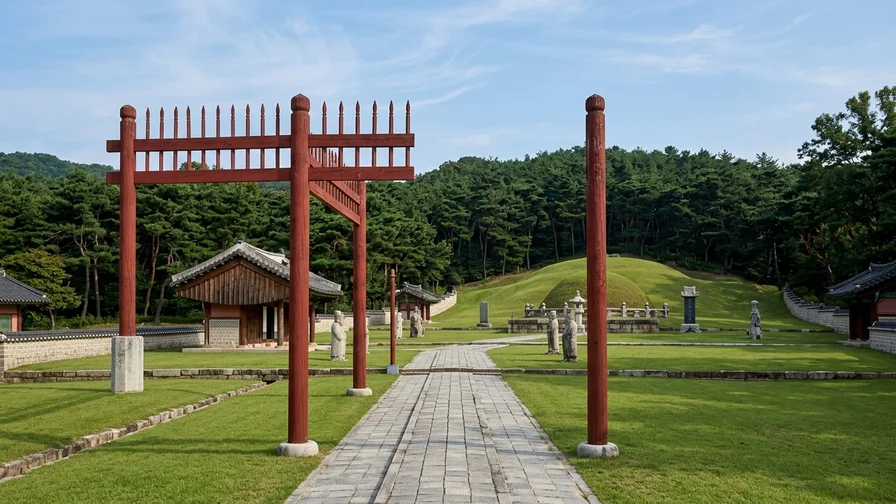
The 40 Royal Tombs of the Joseon Dynasty (UNESCO 2009)
목차
- The 2009 Inscription — Why the Royal Tombs of the Joseon Dynasty Earned Recognition
- Tomb Layout — From the Red Spirit Gate to the Burial Mound
- 5 Recommended Sites for International Travelers
- Jongmyo Daeje and Sanreung Jehyang — Living Ceremonies
- Visitor Information
- Practical Tips for International Travelers
- Frequently Asked Questions (FAQ)
Forty tombs of the kings, queens, and posthumously honored kings and queens of the Joseon Dynasty (1392-1910) are spread across Seoul and the neighboring Gyeonggi-do province. These spaces reveal the burial culture, architecture, and rituals of a dynasty that lasted more than 500 years. Every year on the first Sunday of May, the Royal Ancestral Ritual (Jongmyo Daeje) is held at Jongmyo Shrine, proving that the Royal Tombs of the Joseon Dynasty remain a living heritage.
Key Takeaways
- UNESCO World Heritage: The 40 Joseon royal tombs were inscribed in 2009 for their value as sites preserved in their original form for over 500 years with continuous ritual traditions
- Easy access from central Seoul: Among the 5 recommended sites, Seolleung, Jeongneung, and Taereung are located within Seoul and reachable in about an hour by subway and bus. Donggureung also became accessible without transfers thanks to the opening of Donggureung Station on Subway Line 8 in August 2024
- Practical guide: Includes transportation, travel time, viewing routes, and nearby restaurant information for each tomb, designed so you can travel with just a printout
- Information basis: The admission fees, operating hours, closed days, and transportation details in this article were verified against official sources (Royal Palaces and Tombs Center) as of June 2026
The 2009 Inscription — Why the Royal Tombs of the Joseon Dynasty Earned Recognition
The values recognized by the official UNESCO World Heritage Committee inscription page are as follows.
- A unique style of architecture and landscaping based on Confucian and Pungsu (geomancy) philosophy
- Ritual ceremonies sustained for more than five centuries, surviving as a living tradition
- The complete preservation of the royal tombs of the entire Joseon Dynasty, offering historical integrity that lets you grasp the evolution of tomb architecture at a glance
Except for the two tombs in Kaesong, North Korea (Jeneung and Huneung), all 40 tombs in South Korea were inscribed together as a single heritage spanning 18 locations.
Tomb Layout — From the Red Spirit Gate to the Burial Mound
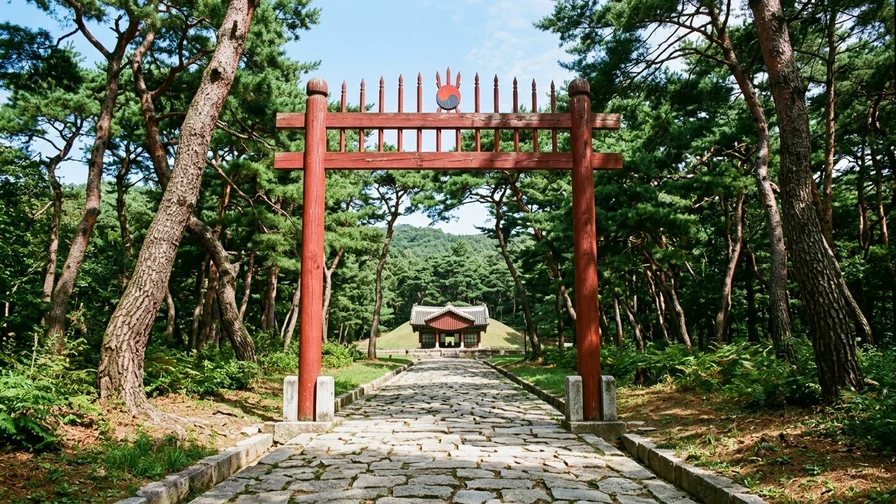
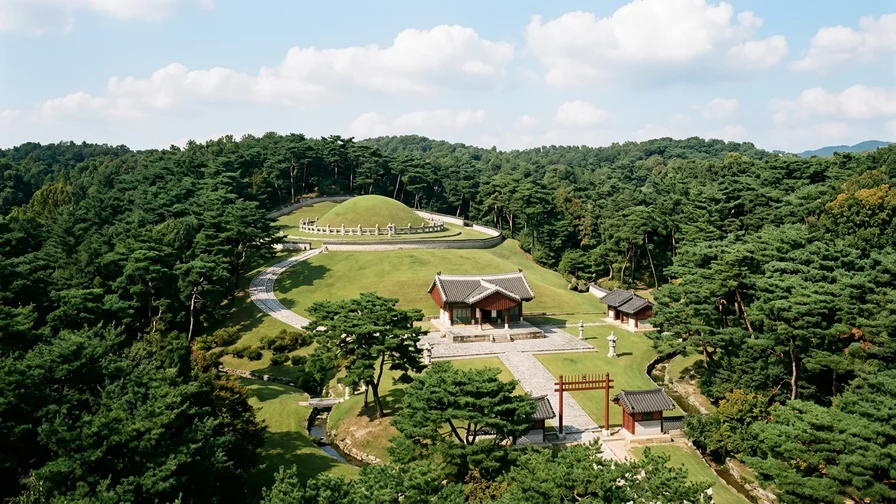
The Joseon royal tombs were built according to fixed rules. Understanding the layout from the entrance to the burial mound makes the visit far more meaningful. Most tombs share the following elements.
- Hongsalmun: A gate of two red wooden pillars topped with spike-like slats, marking the boundary where the sacred area begins
- Chamdo: The path leading from the Hongsalmun to the Jeongjagak, consisting of the higher Shinro (spirit road) on the left and the lower Eoro (king’s road) on the right; visitors walk along the Eoro
- Jeongjagak: A T-shaped building where rituals are performed, used for laying out ritual food and bowing
- Bigak: A building protecting the stele inscribed with the name and achievements of the tomb’s occupant, allowing the occupant to be identified
- Bongbun: The earthen burial mound holding the remains, strictly off-limits to the public, surrounded by twelve-sided Byeongpungseok (protective stone panels) or Nanganseok (stone railings)
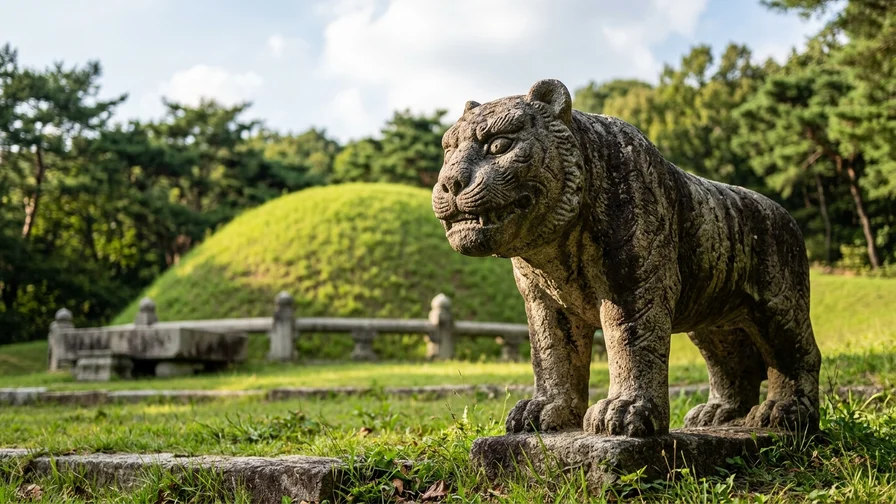
- Seokmul (Stone Figures): Including Muninseok (civil officials), Muinseok (military officials), Seokho (stone tigers), and Seokyang (stone sheep), meant to drive away evil spirits and symbolize royal authority
5 Recommended Sites for International Travelers
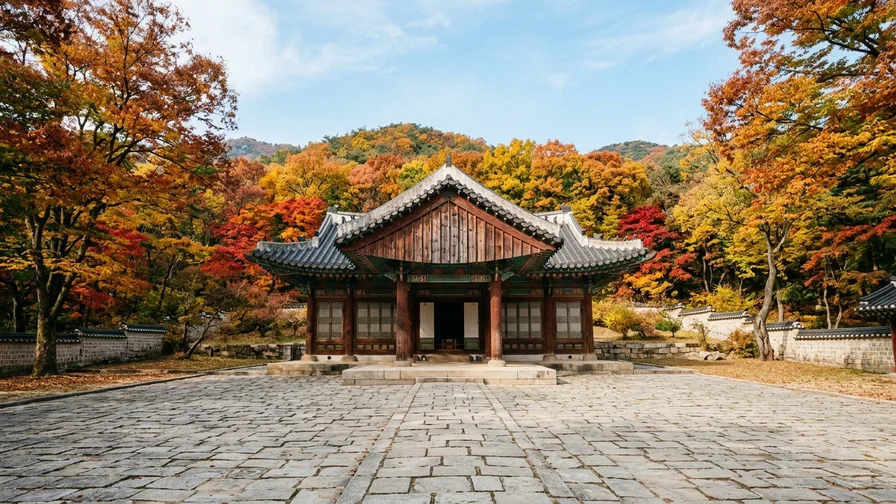
The 40 tombs are scattered across 18 locations. We have selected 5 sites that are highly accessible by public transportation and each have distinct characteristics, with detailed guidance on transportation, dining, and viewing.
1. Donggureung Royal Tombs – The Largest Tomb Cluster
Donggureung is the largest tomb cluster, gathering 9 tombs including Geonwolleung, the tomb of Taejo Yi Seong-gye (founder of Joseon). Beginning with Geonwolleung in 1408, it is the resting place of 17 kings and queens. Surrounded by dense forest, a full tour takes 2-3 hours. If time is short, we recommend focusing on Geonwolleung and Mokneung, which uses three hills within one tomb area (for King Seonjo, the 14th monarch, and his two queens).
- Address: Gyeonggi-do, Guri-si, Donggureung-ro 197
- Transportation (as of June 2026):
- About a 10-minute walk from Exit 3 of Donggureung Station on Subway Line 8. With the Byeollae Line extension opening in August 2024, you can travel from Jamsil Station without any transfers
- By bus, take No. 1, 1-1, or 9-2 from Gangbyeon Station, or No. 88 or 202 from the Cheongnyangni, Sangbong, and Mangu directions, and get off at “Donggureung”
- Viewing Highlight: The silver grass (eoksae) on the burial mound of Taejo’s Geonwolleung. While every other tomb’s mound is covered with lawn grass, only this one is overgrown with silver grass — legend has it that King Taejong brought soil and silver grass from Hamheung to cover the mound, honoring Taejo’s longing for his hometown. If you can see just one thing at Donggureung, make it this silver-grass mound
- Estimated Time: 1.5 – 3 hours
- Nearby Restaurants:
- Hwangje Neungi Baeksuk 📍: Specializes in duck baeksuk and samgyetang made with neungi mushrooms — baeksuk is a Korean restorative soup made by slowly boiling a whole chicken or duck, perfect for a hearty meal after a long tour
- Address: Gyeonggi-do, Guri-si, Donggureung-ro 203
- Dumegol 📍: Specializes in hanjeongsik — a course-style set meal where rice, soup, and a dozen or so seasonal side dishes are laid out together; their handmade beef tteokgalbi (grilled short-rib patties) is also a signature dish, and at prices in the 10,000-won range it has many loyal regulars
- Address: Gyeonggi-do, Guri-si, Donggureung-ro 335
- Onggi Kkotgejang 📍: Specializes in all-you-can-eat soy-marinated and spicy-marinated crab (around 24,000 won per person) — gejang is blue crab aged in soy sauce or spicy seasoning, served as a side dish so addictive it’s nicknamed the “rice thief”
- Address: Gyeonggi-do, Guri-si, Donggureung-ro 206
- Hwangje Neungi Baeksuk 📍: Specializes in duck baeksuk and samgyetang made with neungi mushrooms — baeksuk is a Korean restorative soup made by slowly boiling a whole chicken or duck, perfect for a hearty meal after a long tour
2. Seolleung and Jeongneung Royal Tombs – In the Heart of Gangnam, Seoul
Seolleung and Jeongneung together are called Seonjeongneung. They sit right in the middle of Gangnam’s forest of skyscrapers. The site consists of Seolleung, the tomb of King Seongjong (9th monarch) and his second queen Jeonghyeon, and Jeongneung, the tomb of King Jungjong (11th monarch). Just a 5-minute walk from the subway station, it offers the best accessibility of all 40 tombs. It serves as a walking path for office workers and an urban retreat.
- Address: Seoul, Gangnam-gu, Seolleung-ro 100-gil 1
- Transportation:
- About 400 meters, a 5-minute walk, from Exit 10 of Seolleung Station on Subway Line 2 or the Suin-Bundang Line
- Or use Exit 3 of Seonjeongneung Station on Line 9 or the Suin-Bundang Line
- Viewing Highlight: Seongjong and Queen Jeonghyeon are placed on separate hills within the same tomb area, a layout known as dongwon-igangneung (same area, different hills). Jungjong’s Jeongneung stands alone, separated. The view of Gangnam’s super-tall skyscrapers overlapping beyond the burial mounds is a scene possible only here — the contrast between a 500-year-old royal tomb and a 21st-century skyline captured in a single frame
- Special Note: Unlike other tombs, it opens for night viewing from 06:00 to 21:00 between March and October (as of June 2026), so you can visit for an evening stroll after work
- Estimated Time: 1 – 1.5 hours
- Nearby Restaurants: Given its central Gangnam location, the dining district around Seolleung Station offers a wide variety of Korean food, bunsik (snack foods), and gukbap (rice-and-soup) dishes. The area is packed with great-value baekban (set-meal) spots driven by office-worker lunch demand
3. Taereung and Gangneung Royal Tombs – A Forest Trail Walk
Taereung is the tomb of Queen Munjeong, the second queen of King Jungjong (11th monarch), and Gangneung is the tomb of her son King Myeongjong (13th monarch) and Queen Insun. There is an approximately 1.8 km forest trail connecting the two tombs, but it is not always open — in recent years it has opened only twice a year, in spring (mid-May to late June) and autumn (October to late November). If the forest trail is your goal, be sure to check the opening period in the Royal Palaces and Tombs Center’s announcements before visiting. The nearby Taereung Athletes’ Village makes the name familiar to many Koreans.
- Address: Seoul, Nowon-gu, Hwarang-ro 681
- Transportation:
- From the stop in front of Exit 7 of Taereung Station on Subway Line 6 or 7, take Bus No. 1155, 1156, or 73 and get off at “Taereung Gangneung” (about 10 minutes)
- Or take Bus No. 202 or 1225 from Exit 1 of Hwarangdae Station on Line 6
- You can also take Bus No. 1155 or 1156 from Exit 6 of Seokgye Station on Line 1
- Viewing Highlight: Even though Queen Munjeong’s Taereung is a single tomb where the queen is buried alone, the scale of its stone figures is as large as a king’s tomb — interpreted as evidence of the power she wielded as the one who effectively ruled the country in place of her young son, King Myeongjong. You can really feel it by comparing the height of the civil-official stone figures in front of the mound to a person standing beside them
- Estimated Time: 1 – 1.5 hours (add an hour during the forest trail opening period)
- Nearby Restaurants: Restaurants are scarce around the main gate of the tombs, so realistically it’s best to dine in the dining districts around Taereung Station and Seokgye Station, which lie along the bus route to and from the site
4. Gwangneung Royal Tomb – Paired with the National Arboretum
Gwangneung is the tomb of King Sejo (7th monarch) and Queen Jeonghui. Sejo left instructions to omit the stone chamber and protective stone panels to ease the people’s labor, which greatly influenced the later simplification of royal tomb practices. The surrounding forest has been strictly protected for more than 500 years and is designated a UNESCO Biosphere Reserve. The adjacent Korea National Arboretum is a separate facility from the tombs and requires advance reservation (closed Mondays and Sundays from December to February).
- Address: Gyeonggi-do, Namyangju-si, Jinjeop-eup, Gwangneungsumogwon-ro 354
- Transportation:
- From the Dongbu Plaza stop near Exit 5 of Uijeongbu Station on Subway Line 1, take Bus No. 21 (toward Gwangneungnae) and get off at “Gwangneung” (about 40-50 minutes)
- Bus No. 21 runs with long intervals, so we recommend checking real-time arrivals on Gyeonggi Bus Information (www.gbis.go.kr) or the KakaoMap app before heading out
- Convenient by private car, with parking available
- Viewing Highlight: The first dongwon-igangneung (same area, different hills) layout among the Joseon royal tombs — a single Jeongjagak sits in the center with the tombs placed on two different hills; viewed from in front of the Jeongjagak, Sejo is on the left and Queen Jeonghui on the right. Since later tombs such as Seolleung followed this layout, you’re essentially seeing its original prototype
- Estimated Time: 1 – 1.5 hours (excluding the National Arboretum)
- Nearby Restaurants: There are almost no restaurants right in front of the tombs; they are clustered toward the Gwangneungnae town center, a couple of bus stops away
- Gwangneung Hanokjip 📍: Specializes in Pyongyang-style cold noodles, bibim makguksu, and grilled pork buckwheat wraps — makguksu is a dish of buckwheat noodles tossed cold in seasoning, and the buckwheat wrap is grilled pork wrapped in a buckwheat crepe; you dine in a hanok (traditional house) building, closed Tuesdays
- Address: Gyeonggi-do, Namyangju-si, Jinjeop-eup, Gwangneungnae-ro 36
- Gwangneung Hanokjip 📍: Specializes in Pyongyang-style cold noodles, bibim makguksu, and grilled pork buckwheat wraps — makguksu is a dish of buckwheat noodles tossed cold in seasoning, and the buckwheat wrap is grilled pork wrapped in a buckwheat crepe; you dine in a hanok (traditional house) building, closed Tuesdays
5. Jeongneung Royal Tomb – A Single Tomb in the City
Located in Seongbuk-gu, Seoul, Jeongneung is the tomb of Queen Sindeok, the second queen of Taejo Yi Seong-gye. It originally stood at the site of the British Embassy in Jeong-dong, Jung-gu, but was relocated to its current spot by King Taejong (Yi Bang-won). It is a small site in an urban residential area, quiet and peaceful in atmosphere, often used as a walking path by local residents.
- Address: Seoul, Seongbuk-gu, Arirang-ro 19-gil 116
- Transportation:
- From Exit 2 of Jeongneung Station on the Ui-Sinseol light rail line, about a 10-15 minute walk toward Arirang Market
- Or take Village Bus Seongbuk 22 from Exit 6 of Sungshin Women’s Univ. Station on Line 4 and get off at “Segye Munhwa Yusan Jeongneung” (World Heritage Jeongneung)
- By city bus, take No. 143, 162, or 1014, get off at “Jeongneung Ipgu,” and walk 1 minute
- Viewing Highlight: Although it is the first queen’s tomb ever built in Joseon, some of its stone figures were lost during the relocation, making it simpler than other tombs — the very story of how the tomb of the queen Taejo loved so dearly was pushed outside the capital amid later power struggles is itself the draw of this site
- Estimated Time: 40 minutes – 1 hour
- Nearby Restaurants: Given the residential character of Seongbuk-gu, the area is dominated by baekban (set-meal) spots serving dishes like cheonggukjang (fermented soybean stew) and jeyuk-bokkeum (spicy stir-fried pork), with many places favored by local regulars. On the way from Jeongneung Station to the tomb you’ll find the traditional Arirang Market, where you can sample simple bunsik (snack foods) and market fare
Jongmyo Daeje and Sanreung Jehyang — Living Ceremonies
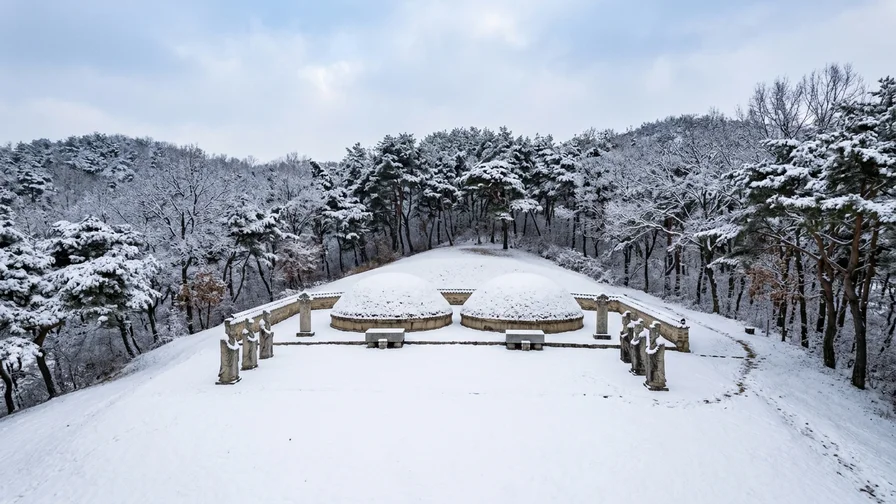
The value of the Royal Tombs of the Joseon Dynasty lies not only in the structures themselves. The fact that the ritual ceremonies continue to this day is the key.
- Jongmyo Daeje: The largest-scale ancestral rite, held on the first Sunday of May each year at Jongmyo Shrine, which enshrines the spirit tablets of past kings and queens. In 2026 it was performed at 14:00 on May 3, accompanied by a royal procession from Gwanghwamun to Jongmyo at 11:00 in the morning. The Jongmyo Jerye ritual and its ritual music were inscribed on the UNESCO Intangible Cultural Heritage of Humanity list in 2001
- Sanreung Jehyang: The annual ancestral rite held at each royal tomb, organized and performed by the Jeonju Lee Royal Family Association, open for public observation
You can check the ritual dates for each tomb on the Royal Palaces and Tombs Center ritual schedule page.
Visitor Information
The information below is based on the official guidance of the Royal Palaces and Tombs Center as of June 2026.
| Category | Details |
|---|---|
| Admission | 1,000 won for adults (about $0.8). For foreigners, those aged 18 and under and 65 and over are free; for Koreans, those aged 24 and under and 65 and over are free. |
| Operating Hours | Generally opens at 09:00. Closing is 18:00 in February-May and September-October, 18:30 in June-August, and 17:30 in November-January. Last admission is 1 hour before closing. Seonjeongneung has extended hours of 06:00-21:00 from March to October, and Donggureung and Seoul’s Jeongneung also open early at 06:00. |
| Closed Days | Every Monday (for all tombs). When a Monday falls on a public holiday, the tombs may open and close the following day instead, so it’s best to check the official website before visiting. |
| Language Support | Major tombs have information signs in English, Chinese, and Japanese. Some tombs offer docent guidance with advance reservation. |
| Official Website | royal.khs.go.kr (Royal Palaces and Tombs Center, Korea Heritage Service) — the single official source for hours, fees, closures, and ritual schedules |
Editor’s Tip: The last Wednesday of every month is “Culture Day,” when most tombs offer free admission. The 6,000-won (about $4.8) “Integrated Palace Ticket” allows one visit each to the four main palaces (Gyeongbokgung, Changdeokgung, Changgyeonggung, Deoksugung) and Jongmyo for 6 months from the date of purchase, but the Joseon royal tombs are not included, so you’ll need to buy a separate tomb ticket (1,000 won).
Practical Tips for International Travelers
- Transit Card: A rechargeable T-money or Cashbee card is essential; you can buy and recharge them at subway stations and convenience stores, and they apply transfer discounts between buses and subways
- Limits of Taxi Apps: Kakao T and Uber require Korean phone verification and registration of a domestically issued card, which restricts use for foreign travelers; hailing on the street or arranging a hotel taxi is more convenient
- Comfortable Shoes: The grounds are mostly dirt paths and sloped hills, so sneakers or hiking shoes are recommended
- Photography Etiquette: Photography is allowed in most areas, but be careful not to disturb ongoing rituals; tripods and commercial shoots may require prior permission
- Traveler Support: The 1330 Korea Travel Helpline run by the Korea Tourism Organization offers 24-hour assistance in English, Chinese, and Japanese (dial 1330 with no area code from within Korea)
Frequently Asked Questions (FAQ)
- Q1: Can I go directly inside the burial mound (tomb)?
- A1: No. The burial mound and surrounding area are sacred space where public entry is strictly forbidden. You must follow the designated viewing path.
- Q2: Do I have to visit all 40 royal tombs?
- A2: No need. The 40 tombs mostly share a similar structure. Visiting just 1-2 of the recommended 5 sites, or whichever fit your route, is enough to fully understand the characteristics of the Joseon royal tombs.
- Q3: Are there restrooms or amenities within the tombs?
- A3: There are restrooms at the entrance of every tomb. Some larger tombs (e.g., Donggureung) have a small shop or café, but most have only beverage vending machines. It’s a good idea to bring water in advance.
- Q4: Can I visit on a rainy day?
- A4: Yes, you can. Since it’s an outdoor space, you should bring an umbrella or rain gear. However, in very bad weather such as a typhoon or heavy snow, entry may be restricted for safety reasons.
- Q5: How are the royal tombs different from Jongmyo?
- A5: The Royal Tombs are graves holding the bodies of kings and queens. Jongmyo Shrine is a shrine that enshrines the spirit tablets of past kings and queens and performs ancestral rites for them. If the royal tombs are where the body rests, Jongmyo is where the spirit is honored.
- Q6: Can I visit with a wheelchair or stroller?
- A6: The flat paths from the entrance to the Jeongjagak are mostly accessible. However, the burial mound hills and forest trails have stairs and dirt paths that are difficult for wheelchairs or strollers. Some tombs are equipped with accessible restrooms.
Visiting the Royal Tombs of the Joseon Dynasty is a way to experience Korea’s history, architecture, and nature all at once. We hope this guide proves concrete and genuinely helpful for exploring the cultural heritage scattered across Seoul and its surroundings. Schedules and closure notices may change, so it’s best to double-check the official Royal Palaces and Tombs Center website before your visit.
Related Reading on This Topic
- 17 UNESCO World Heritage Sites in Korea
- Haeinsa Janggyeong Panjeon & Tripitaka Koreana (UNESCO 1995)
- Gyeongju UNESCO World Heritage (1995, 2000)
- 9 Korean Seowon Confucian Academies (UNESCO 2019)
- Jeju Volcanic Island and Lava Tubes (UNESCO 2007)
- Jongmyo Shrine (UNESCO 1995)
- Changdeokgung Palace & Secret Garden (UNESCO 1997)
- Suwon Hwaseong Fortress & Haenggung Palace (UNESCO 1997)
- Gochang, Hwasun & Ganghwa Dolmen Sites (UNESCO 2000)
- Andong Hahoe & Gyeongju Yangdong Villages (UNESCO 2010)
- Namhansanseong Fortress (UNESCO 2014)
- Baekje Historic Areas (UNESCO 2015)
- Sansa, 7 Buddhist Mountain Temples in Korea (UNESCO 2018)
- Getbol, Korea's 4 Tidal Flats (UNESCO 2021)
- Gaya Tumuli, 7 UNESCO Sites (UNESCO 2023)
- Bangudae Petroglyphs (UNESCO 2025)