Hot Springs After Hiking — Recovery Spots Near Korea’s Peaks
목차
- The Quick Version
- Recharging After the Hike: The K-Wellness Trend Explained
- Best Hot Springs After Hiking: Spa Experiences Near the Peaks
- First-Timer’s Jjimjilbang Guide and Booking Forest Therapy
- Settling the Mind: Forest Therapy and Meditation Programs
- Healthy Eating With Local Specialties: The Local Food Experience
- Designing Your Own K-Wellness Course: A Custom Rest Plan
The Quick Version
- Soaking in hot springs after hiking is a classic Korean recovery routine that uses warm mineral water to quickly loosen tired calf and thigh muscles.
- We’ve grouped trailhead-adjacent spots by mountain, including Osaek Carbonated Hot Spring next to Seoraksan, the National Center for Forest Therapy near Sobaeksan, and Jirisan Spa Land, with addresses, prices, and booking details.
- You’ll also get a first-timer’s walkthrough of the jjimjilbang (Korean sauna), how to book forest therapy programs, and what to eat afterward, all laid out so a first-time visitor can follow it step by step.
Once you peel off those sweat-soaked hiking boots, the next thing that matters is recovery. In Korea, soaking in hot springs after hiking and then finishing with a slow walk through the forest has become a wellness routine all its own. In this guide we group the hot springs and forest-therapy facilities closest to each famous peak, with addresses, prices, booking channels, and a first-timer’s guide to the jjimjilbang all in one place. For the big-picture overview of trekking Korea’s famous mountains, check our pillar guide.

Recharging After the Hike: The K-Wellness Trend Explained
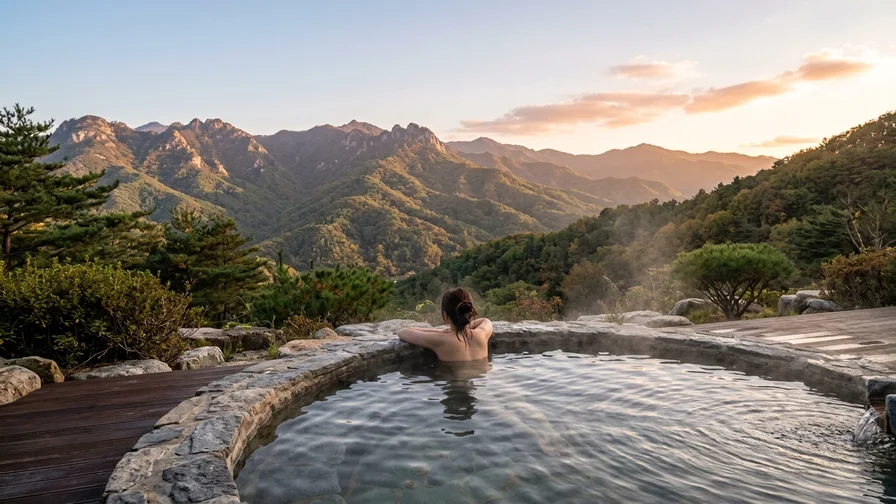
Pairing hot springs after hiking with forest therapy as a single set is catching on fast among travelers in Korea. You spend a full day on the ridgeline, sink into hot water that evening, then spend the next day walking a gentle flat forest trail. Treating recovery itself as part of the trip is an idea that’s now firmly taken hold with international visitors too.
Why Recovery in Nature Matters
A hot soak uses the warmth of the water to boost blood flow, which helps unknot the calves and thighs you’ve worked hard on the trail. Forest therapy is about walking slowly among the phytoncides, shade, and birdsong of the woods while you steady your breathing. Korea has institutionalized this to the point that the government runs national forest-therapy facilities as part of its forest-welfare policy.
The key is dialing back the intensity. Rather than booking another punishing itinerary the day after a hike, leave the day open for low-impact activities like a hot-spring soak and a forest stroll, and you’ll feel the difference on your next outing. The recovery day is exactly the piece foreign travelers tend to skip.
The Wellness Infrastructure Around the Big Peaks
Korea’s famous mountains tend to have hot springs and forest-therapy facilities close at hand. There’s a natural carbonated spring right beside the Osaek trailhead at Seoraksan, a national forest-therapy center in the Sobaeksan area, and a hot-spring resort near Nogodan in the Jirisan zone. In other words, you can handle both the hike and the recovery within the same area.
- The Seoraksan area is built around hot-spring bathing, so it suits an easy route straight to a soak on the same day you hike.
- The Sobaeksan area runs reservation-based forest-therapy programs that work well for a recovery day afterward.
- The Jirisan, Woraksan, and Hwawangsan areas all have a mix of hot-spring resorts and public bathhouses, so you can choose based on how long your trip is.
Best Hot Springs After Hiking: Spa Experiences Near the Peaks
When choosing where to soak in hot springs after hiking, distance from the trailhead matters most. After a full day on your feet, a long transfer cancels out half the benefit, so it’s best to stay within the same area when you can. The table below is a quick, by-mountain summary of vetted facilities. Prices and hours change, so confirm with each facility before you go.

A Tour of the Best-Known Hot-Spring Areas
Osaek Carbonated Hot Spring (오색탄산온천) sits at 34 Daecheongbong-gil, Seo-myeon, Yangyang-gun, Gangwon State 📍. It’s right next to the Osaek trailhead of Seoraksan (설악산), which means you can walk over and soak the moment you finish the descent. The water is a natural carbonated spring; hours are 06:00–22:00 on weekdays and 06:00–23:00 on weekends, and admission is 18,000 KRW (about USD 13, subject to change, confirm before visiting).
Suanbo Hot Spring Land (수안보온천랜드) is at 32 Jujeongsan-ro, Suanbo-myeon, Chungju-si, North Chungcheong Province, and pairs nicely with the Chungju and Woraksan area. A private family bath runs around 40,000 KRW for two hours (about USD 30, subject to change), which is handy when your group wants to soak separately. You can book by phone at 043-855-8400; staff respond mainly in Korean, so Google Translate or your accommodation’s front desk makes it easier.
Bugok Oncheon (부곡온천) is Korea’s flagship sulfur hot-spring district, located in Bugok-myeon, Changnyeong-gun, South Gyeongsang Province. It pairs well with the Hwawangsan area, and a public bath is an easy 8,000–9,000 KRW (about USD 6–7, subject to change). Hours are generally 05:00–23:00, but they vary by business, so it’s safest to check before you go.
Jirisan Spa Land (지리산온천랜드) is a hot-spring resort at 261 Jirisan-oncheon-ro, Sandong-myeon, Gurye-gun, South Jeolla Province. It’s near Nogodan and Seongsamjae on Jirisan (지리산), making it a good recovery base after a traverse or the Nogodan route. Exact prices and hours change, so confirm in advance via Google Maps or by phone.
Combining Forest Bathing With the Spa
If a soak alone feels like it isn’t enough, add a forest-bathing walk the next day. Where the hot spring releases muscle tension, forest bathing is recovery through slow walking on a flat forest path while you steady your breath. The intensity is low, so it fits perfectly as a condition-recovery day after a hike.
| Facility | Price & Hours | Nearby Mountain |
|---|---|---|
| Osaek Carbonated Hot Spring 📍 34 Daecheongbong-gil, Yangyang |
Adult 18,000 KRW Weekday 06:00–22:00, weekend 06:00–23:00 |
Seoraksan (Osaek) |
| Suanbo Hot Spring Land 32 Jujeongsan-ro, Chungju |
Family bath ~40,000 KRW / 2 hrs Booking 043-855-8400 |
Woraksan |
| Bugok Oncheon Bugok-myeon, Changnyeong |
Public bath ~8,000–9,000 KRW Generally 05:00–23:00 |
Hwawangsan |
| National Center for Forest Therapy 209 Therapy-ro, Yeongju |
2-hr guided trek 10,000 KRW Booking 054-639-3400 |
Sobaeksan |
| Jirisan Spa Land 261 Jirisan-oncheon-ro, Gurye |
Price varies, confirm by phone Resort hot spring |
Jirisan (Nogodan) |
Prices and hours can shift by season, so confirm with each facility before you visit.
First-Timer’s Jjimjilbang Guide and Booking Forest Therapy
If Korean-style hot springs and the jjimjilbang are new to you, the order of operations can feel unfamiliar. Learn the steps below and you’ll move smoothly from entry to wrap-up.

How to Use a Jjimjilbang for the First Time
- Pay the entry fee at the front and receive a towel and loungewear, the matching outfit you wear inside the jjimjilbang.
- Put your shoes in the shoe locker and use the key you’re given to claim a clothing locker for your belongings.
- The bathing area is separated by gender, and inside the pools it’s standard Korean practice to bathe nude without a swimsuit.
- Once you change into the loungewear, you can relax together in the mixed-gender sauna lounge.
- Eggs roasted on hot stones and sikhye, a sweet traditional drink fermented from rice, are the signature jjimjilbang snacks.
- Many places have sleeping rooms, so a short nap or even an overnight stay is possible.
One thing to watch is entry restrictions. Large tattoos may keep you out of some baths, and you can be refused entry after drinking for safety reasons. Drink plenty of water before and after soaking, and if you feel dizzy, get out of the bath right away.
Donghyun’s on-site brief
Bring a little cash and a coin purse when you head to a hot spring. Traditional springs and rural public baths often don’t take cards, and the drink vending machines and egg counters are frequently cash-only. Some places have no English signage at all, so pull up the facility photos on Google Maps and have a translation app open ahead of time, and the entry process gets a lot easier.
Booking a Forest Therapy Program
The National Center for Forest Therapy (국립산림치유원) is a national facility at 209 Therapy-ro, Bonghyeon-myeon, Yeongju-si, North Gyeongsang Province, near Sobaeksan (소백산). It’s open year-round and runs same-day, short, and long-stay forest-therapy programs by reservation. A two-hour trek accompanied by a forest-healing specialist costs 10,000 KRW (about USD 7, subject to change), a fitting entry-level course for anyone trying forest therapy for the first time.
- You can book by phone at 054-639-3400 or through the official website, and foreign visitors should first confirm whether English-language support is available when calling.
- Programs combine meditation, forest walking, and a healing meal, with set sessions and limited capacity, so it’s safest to reserve ahead.
- Even without a reservation, anyone is free to walk the individual forest trails around the facility.
During the wildfire-prevention seasons in spring and autumn, some high-altitude forest trails may be closed, so if you plan to walk in forest zones, check for closures on the Korea National Park Service website in advance.
Settling the Mind: Forest Therapy and Meditation Programs
Forest therapy isn’t just a stroll; it’s a recovery method focused on breathing and pace. Unlike a steep climb, you walk slowly on flat or gently sloped forest paths, so it helps calm the mind the day after a hike without straining your legs.
A Guide to Joining a Forest Therapy Program
At facilities like the National Center for Forest Therapy, a specialist accompanies the program and guides your breathing and walking pace. If it’s your first time, starting with a guided trek of around two hours keeps the load light. Comfortable sneakers, a light jacket, and a bottle of water per person are all you need.
Experiencing a quiet templestay at a mountain temple is another excellent wellness activity. Through dawn services, the formal monastic meal, and meditation, you can settle a body and mind still buzzing from the hike.
How to Meditate in the Forest
There’s a simple meditation you can do in the forest with no special gear. Here are the steps, laid out so a first-time visitor can follow along.
- Sit on a shaded, flat spot or stop slowly where you stand, and let the tension drop from your shoulders.
- Breathe in slowly through the nose for four seconds and out long through the mouth for six seconds, repeating five times.
- Close your eyes and focus only on the sounds of the forest, the birds, the wind, the water.
- When you start walking again, move at half your usual speed and pay attention to the feel of your soles meeting the ground.
Healthy Eating With Local Specialties: The Local Food Experience
The final stage of recovery is eating well. Around the famous peaks you’ll often find a spread built from seasonal wild greens that grow in that very region, perfect for waking up your appetite after working up a sweat.

Seasonal Mountain Vegetable Dishes
Sanchae jeongsik (san-chae-jeong-sik) is a full table set of various wild-green side dishes served with rice and soup. Greens that grow on the local mountains, such as chwinamul, gosari (bracken fern), and deodeok root, are dressed with perilla oil and soy sauce, and the spread is mostly vegetables, so it’s light. It goes easy on a stomach worn out from hiking, which makes it a great recovery meal.
- The soy sauce and perilla oil used in the dressed greens can contain gluten and sesame, so if you have allergies it’s safest to mention them when ordering.
- Most dishes are vegetable-based, but some side dishes or broths may use seafood stock such as anchovy or salted shrimp, so strict vegetarians should check the ingredients.
- Kitchens and tools are shared, so if you’re sensitive to cross-contamination, ask the restaurant in advance.
Local Specialty Liquors and Healthy Drinks
A common traditional drink to pair with the meal is makgeolli, a cloudy fermented liquor brewed from rice. There’s a culture of enjoying a glass after a hike, but when you’re dehydrated, water and electrolytes come before alcohol. Drinking is purely optional, and if you’d rather skip the alcohol, sweet traditional drinks like sikhye or sujeonggwa are a good alternative.
Wild-green side dishes and makgeolli are often served together near the mountains, but if you plan to drive, skip the alcohol and keep the focus on recovery.
Designing Your Own K-Wellness Course: A Custom Rest Plan
Now it’s time to map out a route by mountain. Put hot springs after hiking at the center, then add forest therapy and a meal depending on how long your trip is. Drop the flow below into your calendar and it becomes your itinerary.
- For a same-day recovery plan, descending the Osaek route on Seoraksan, soaking at Osaek Carbonated Hot Spring, and finishing with sanchae jeongsik around Yangyang is an efficient combination.
- For a two-day recovery plan, hike Sobaeksan on day one and book the guided-trek program at the National Center for Forest Therapy on day two to ease the body slowly.
- After a Jirisan traverse or the Nogodan route, soaking at Jirisan Spa Land and eating around Gurye makes for a natural flow.
- For the Woraksan or Hwawangsan area, pair the family bath at Suanbo Hot Spring Land or the public bath at Bugok Oncheon and choose based on your group.
Many of the outlying hot springs and forest-therapy centers have infrequent bus service. For exact routes and schedules, enter your departure point and the facility name in Naver Maps or Google Maps to pull up live bus numbers and times. Foreign visitors planning to rent a car must get an International Driving Permit in their home country before departure, as it cannot be issued after arriving in Korea. The Kakao T taxi app often requires a Korean phone number and a domestically issued card to register and pay, so short-term travelers may find it hard to use; consider also flagging taxis from the stands at train stations and terminals.
Hot-spring operating hours and prices, and the bookable sessions for forest-therapy programs, vary by season. Reconfirm through each facility’s official channel or Google Maps before you set off, and a bit of background on hot-spring culture makes a first visit easier. Pin the dates on your calendar first, then lock in your hot-spring soak and forest-therapy session today.
Related reads in this series
- Hiking Mountains in Korea, How to Pick Your First Peak
- Bukhansan by Subway from Seoul — Baegundae Route and How to Get There
- Seoraksan from Sokcho — Cable Car to Daecheongbong Peak
- National Park Trekking in Korea, Reservations, Closures and Shelters
- Reach Korean Mountains by Public Transport, No Car Needed
- Jirisan Hiking — Trails and Access from Nogodan to Cheonwangbong
- Hallasan Hiking to Baengnokdam via Seongpanak and Gwaneumsa
- Naejangsan Autumn Hiking by Train, Seoraebong and Sinseonbong
- Sobaeksan Hiking — Shortest Route to Birobong Peak and the Azalea Ridge
- Baekdudaegan Mountain Range, Korea's Spine and One Hike